Oset och Rynningeviken & Örebro Summary
This afternoon in Örebro, or close thereto, I spent most of my time in the Oset och Rynningeviken nature reserve (“och” is Swedish for “and”), and I didn’t visit an art gallery. (More on the art gallery I didn’t visit below.)
Tomorrow morning, I’ll be leaving Örebro for my next destination (heavy sigh), so I’ll put a summary of my time in Örebro at the end of this post.
Oset och Rynningeviken

Oset och Rynningeviken is a large nature reserve. One of its boundaries is the Svartån, the river that flows through Örebro. Another boundary is Lake Hjälmaren, into which the Svartån flows.
I walked along the riverwalk beside the Svartån to get to the Oset och Rynningeviken reserve, but where I entered and the restaurant where I ate lunch are about as far from Lake Hjälmaren in the park as you can get.
I’m going to jump around temporally here because it will help the narrative. Don’t worry, I’ll get back to my description of my experience in Oset och Rynningeviken soon.

After I’d walked around the reserve for a while and got close to Lake Hjälmaren, I passed another entrance to the reserve. There was a large sign with a lot of descriptive text about Oset och Rynningeviken’s past and present. The text had both Swedish and English versions.
The history of Oset och Rynningeviken was, to say the least, quite checkered. However, without that checkered past, there wouldn’t be a nature reserve today.
Here’s the story.
Örebro used to extend to the shore of Lake Hjälmaren. It doesn’t today. The city didn’t shrink. The lake did.

There was a famine in Sweden in the 1800s, and there wasn’t enough farmland. To help alleviate the problem, they lowered Lake Hjälmaren two metres. The then exposed land was put to use as farmland.
It didn’t work out entirely according to plan. The land wasn’t particularly arable and was eventually abandoned and became overgrown.
Then the military took it over as a training ground. It also started to be used as a dump. Then, heavy industry and an oil harbour were built there.

That all ended in the late 1990s. Over the succeeding twenty years, the land was decontaminated, the overgrowth cleared, and new wetlands, pastures and meadows were created. And today there is the stunning Oset och Rynningeviken nature reserve.
Pretty amazing story, right?
Okay, let’s skip over my whole time in Oset och Rynningeviken. As I was leaving, back at the same spot I entered, on the wide trail that passes by the restaurant, but just a little farther into Oset och Rynningeviken than the walk that peals off to the restaurant, there was signage identical to what I saw at the other end of the reserve.
Had I taken an ever-so-slightly different path out of the restaurant, or had I been ever so slightly more observant, I could have gotten that information before beginning my exploration of Oset och Rynningeviken, and I could have avoided giving you whiplash by jumping through space and time on this post.

Torsten Molander, 1998
That diversion out of the way, let’s get back to my experience of the reserve.
It’s awesome.
Okay. That said, let’s go for a drink.
Wait. You want more?
Damn, you people are hard to please.
Having read about the history, it’s hard to believe that, if I did the arithmetic correctly—started in the late 1990s, took 20 years, and it’s now 2025—it’s less than a decade after they finished rehabilitating the land, and today it looks as if there never was anything but a nature reserve there.
Paths wind through Oset och Rynningeviken, through peaceful forests and meadows, past small ponds, lagoons and marshes, and over a bridge fording a small river.

Around the edges of the pond and lagoons, and in the marshes, tall grasses grow. I was about to call them reeds, but I’m conscious of the fact that I know nothing about botany.
I tend to call any plant with tall stalks that grows along the banks of a body of water a reed, even though most aren’t.
If you hear me call something a reed and you can’t witness the plant with your own eyes, you can be certain it’s not a maple tree, but it could be almost any other plant.
As I walked along, I often heard birds chirping or cawing and, close to the ponds and lagoons, I frequently heard frogs croaking. (Croaking as in the sounds frogs make, not croaking as in dying.)

At one point in my walk, I forget exactly where it was, I passed a sculpture. The base was a tall, square stone, much taller than it was wide and deep. On top was a stone sculpture of a monkey or some other non-human primate. Beside it was a smaller bird, and behind it sat another bird. With the help of Google Translate, a sign on the pedestal told me that the title of the piece was “Bird Temple.”
Um, bird temple? Excuse me? Can we talk about the primate in the room, please? It dominates.
And, a monkey or other non-human primate in Sweden? That seems unlikely, doesn’t it? Sounds like fauna appropriation to me. Is that politically correct?

Then there’s Lake Hjälmaren. When I got close to it, near where I saw that sign with all of the information about Oset och Rynningeviken, there was a field where a small herd of cows—adults and calves—were grazing on grass. Of course, you probably could have guessed that if they were grazing, it would probably be on grass. But that grazing on grass alliteration was right there. I had to grab it.
In Lake Hjälmaren, close to the shore in Oset och Rynningeviken, there were a lot of water lilies. When I was there, a few of them were just starting to bloom. None had full blossoms, but the buds on some of them were beginning to show some colour.

At that point, you have to look fairly far out to see open water.
Following the path away from the lake, back to the entrance where I came in, at one point, the path goes on a wooden bridge over some water. Partway along the bridge, there’s a deck beside it. The deck has a beautiful view of the lake and that portion of the reserve. Benches surround three-and-a-half sides of the deck, with only an opening so you can walk onto the deck. Sitting on one portion of the benches and affixed to the railing is one of those little libraries that you see in some urban neighbourhoods, where people can drop off and pick up books.
The shelves were full. I looked at the spines of the books. They were all Swedish, but I imagine that if you read Swedish, it would make for a great afternoon to come out there, grab a book, have a seat, and read surrounded by all of that nature.

The walk back from the lake to the entrance displayed yet more beauty, but of the variety I’ve already described, so I won’t repeat myself.
The weather when I was in Oset och Rynningeviken started mostly cloudy, but with some sun. Well into my walk, it started to drizzle. Rain had been predicted, so I brought my rain jacket and umbrella. The intensity never rose to more than a few sparkles. So I made do with just my rain jacket.
After a while, the showers stopped and the centre of the sky was almost clear. The sun beat down on me, but a ring of heavy clouds fringed the horizon in all directions.

Then the cloud cover closed in again, and there were a few more sprinkles.
I ended up spending well over two hours in Oset och Rynningeviken, not including lunch. Had it not been for the still threatening weather, I would have stayed longer. It was gorgeous.
Not yet late in the afternoon, I decided to take in one more attraction I found in my guidebooks, an art gallery, Konsthall. Because it’s on the far side of Örebro, Apple Maps told me it would take close to an hour to walk there.
I took a slightly different route back. It was pleasant, but didn’t have as many distractions as the route I took this morning, particularly because there was some overlap. So I made it in about the time Apple Maps told me I would. But …

Not Konsthall
I had checked the English page that Konsthall provides on its website, and it told me that it would indeed be open until 6:00 p.m. today, more than enough time for me, and then some. That page also told me that it’s part of the City of Örebro’s Art Department, which manages the city’s art collection. Most of the collection is outdoor art, but they also hang some of their collection in Konsthall.
When I got there, there was a professionally printed sign on the door, only in Swedish. Google Translate told me it said that “Örebro Art Center is temporarily closed for renovation. Welcome to the next exhibition Halrummet/The Cavi, with Asa Jungnelius, which opens Friday 13 June at 5 pm.”
Today is Wednesday, June 11. I leave tomorrow. It seems there is indeed a full-fledged chapter of DLJSSIA (Don’t Let Joel See Stuff International Association) in Örebro after all.
With that failure, I still had some time in the afternoon. I walked around a little more in the centre of the city—mostly places I’d already walked through—and found I nice parkette by the river, close to Örebro Slott, with some wooden, reclined benches. I had a seat, or rather a recline, for a while, took in the view, people watched, and entered a few words into my journal on my phone.
Then it was time to head back to my hotel. Tomorrow, I leave for my next destination. Sigh.
Örebro
I loved Örebro. It’s naturally beautiful with its river and channels off it and its parks. I’ve mentioned a few specific parks in these pages, but there are also small parks scattered around the centre of the city, particularly close to the castle.
The streets are very pedestrian-friendly, including one or two fully pedestrianized streets.
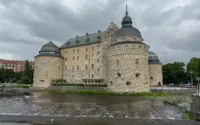
Much of the architecture is charming and/or grand—Örebro Slott, the castle, fits in the grand category. And it’s all built at a human scale.
I’m sorry I booked only two nights here.
I get the sense that they don’t put a lot of effort into tourism here. There aren’t many tourist attractions listed across my three guidebooks. I saw pretty much all of the ones they list. I think the city focuses more on making Örebro a great and enjoyable place to live. But that also makes it a great place to visit.
With another day or two, I would have spent more time taking in the ambience. And I probably would have walked a little farther afield in the city to see if I could find anything to complain about here. I’m out of my comfort zone if I don’t have anything to complain about.
Discover more from Joel's Journeys & Jaunts
Subscribe to get the latest posts sent to your email.

I hardly know what to say. What a commendation! You’ve got to admire a place that not only rehabilitates their industrial lands, giving them back to nature, but provides a little free library so you can enjoy nature AND read. Not to leave a place without a single kvetch, there was the matter of the art gallery cleverly hunkering down until the day after you left to reopen. There is always that. Otherwise, Örebro seems to have hit all the right notes. I am glad you enjoyed it so much. I enjoyed coming along with you. Lovely photos.
Yeah, I’ve really loved Örebro. I’ll forgive them closing the gallery for me.
I’m glad you enjoyed it.
Örebro Seems the Goldilocks of communities. Just right. A few months a year in Örebro might be just the tonic for weary souls—travelers, jet-setters, urbanites alike.
I didn’t think of the Goldilocks analogy, but it fits for Örebro. Just right.