Riddarhuset and More
This morning in Stockholm, I returned to Gamla Stan to visit Riddarhuset and see a couple of other sights. It was a grey morning with threatened rain and a few real drops of water, but it was enjoyable nonetheless.
Riddarhuset

Google Translate indicates that “Riddarhuset” means “The Knight’s House” in English. My guidebook translates it to “House of Nobility.”
I believe that knights are part of the nobility. So I’ll accept that.
Regrettably, I’m not a knight. Surely that’s just an oversight on the part of the knighthood powers that be. Nevertheless, I think being noble is something to strive for. I hoped the House of Nobility would give me some pointers in that direction.
Sweden’s 16th-century parliament consisted of four estates: the nobility, the clergy, the burghers, and the peasants. (Did burghers eat burgers? I think they should have been forced to for the homophone symmetry of it.)

The nobility was considered to be the First Estate, and they had exclusive rights to the highest offices.
You can be damn sure the peasants didn’t get it. Power to the people! (Unless I can get into the nobility. In which case, the heck with the people. Let them eat stale white bread. They don’t deserve cake.)
Completed in 1647, Riddarhuset gave the nobility a place to hold meetings and other events. Heaven forbid that they should have to book a meeting room at the 17th-century equivalent of a Holiday Inn. They might have to interact at the same level with the peasants there.
The last knighthood in Sweden was handed out in 1902. The right to ennoble people was taken away from the King of Sweden in 1974. Damn! They dashed my hopes of getting a knighthood in Sweden. Can my king, King Charles, still do that sort of thing? Does anyone have an in with him? Or an inn with him? It’d be cool to stay in one of his palaces.

Today, Riddarhuset is used by people who keep genealogies, administer grants and scholarships, and take care of the palace.
They sparingly allow the plebs, such as me, to enter. During most of the year, they open it to the public for one hour a day, Monday through Friday.
During the summer season, which, according to them, started less than a week ago, they open for three hours, 10:00 a.m. to 3:00 p.m., Monday to Friday.

My guidebook says that Riddarhuset is “often regarded as one of Stockholm’s most beautiful buildings.”
I’m not going to make a comparative value judgement like that. Stockholm has many gorgeous buildings. Riddarhuset is indeed beautiful. But, among the most beautiful? Tough call.
Its exterior is gracefully simple. Several sand-coloured columns adorned only at their tops break up tangerine-coloured brick. Rectangular windows with eyebrow-like arches over turn are set into the brick.

There is what looks like a refined, heavily manicured garden out back. It was blocked by road construction. I don’t know if it’s normally open to the public, or if I would have found it open if I approached from the other side.
When Riddarhuset is open, the public is allowed into just three rooms beyond the vestibule: The Blue Room, the Great Hall, and the Land Marshals’ Hall.
I said, “beyond the vestibule,” but the vestibule is quite stylish in itself. A handsomely austere double staircase, with the start of one staircase on either side of the room, leads up to the rooms upstairs. And there are also a couple of elegant chandeliers in the vestibule.
The Blue Room and the Great Hall are at the top of those staircases.

Unlike the Blue Room in Stockholm City Hall, the walls of the Blue Room in Riddarhuset are indeed blue, hence the name. In the middle of the room, there’s a table with a chandelier over it. Against some of the walls, there are glass-fronted cabinets. Some hold stylishly decorated china. Another cabinet or two holds several of what look like stamps for creating seals in wax. Each has a stem with engraving on the stubby end.
The Great Hall is, well, a great hall. It holds several blue-upholstered benches facing a table with an upholstered straight-back chair. Long rows of those benches face the front of the table and chairs. There are also two sets of shorter rows of benches, each set facing the other, on either side of the table and chair.

I’d like to tell you what colour they painted or papered the walls, but I can’t. The walls are entirely covered by coats of arms. The leaflet available at the ticket desk told me that there are 2,332 noble coats of arms there. It didn’t say how many ignoble coats of arms there are. What are they trying to hide?
The ceiling isn’t covered by coats of arms, noble or ignoble. There’s a painting on it.
The Land Marshals’ Hall is down a set of stairs from the Great Hall. Its main room has a beautifully sculpted ceiling, with chandeliers hanging down from it. On the walls, there are 54 portraits of the nobility’s speakers at the Riksdag (Parliament) of the Estates.
And More

Being in Gamla Stan, there was still more to see there and streets untrod by me on this trip, despite the time I’ve already spent here in Stockholm’s Old Town.
I went to two sights recommended by my walking tour app or guidebook, I forget which. Neither were buildings to go into. One was a terrace, the other was a public square.
Evert Taubes Terrass

Evert Taubes Terrass is a terrace close to Riddarholmskyrkan, which I saw the other day, and facing the water. Not surprisingly, it’s dedicated to Evert Taubes (1890-1976). He was a beloved Swedish author, artist, composer, and singer.
The terrace has great views of the Stockholm City Hall across the water. In the other direction, there’s a part of Stockholm across a channel that I haven’t gone to and likely won’t get to see on this trip, other than from a distance. However, from a distance, it looks charming.
There are a lot of benches in Evert Taubes Terrass. I took advantage of one of them for a while.
Gåstorget (Goose Square)

Gåstorget is a small public square nestled in the middle of Gamla Stan. A large tree and a bunch of tables and chairs for a restaurant facing it pretty much fill up Gastorget.
Off to one side of the square, there’s a small statue. It’s of two pugilists duking it out with a small crowd of bodiless heads watching.
Gåstorget is Swedish for Goose Square. I didn’t see any geese when I was there.
According to my walking tour app, Gåstorget “dates back to 1730 when Johan Eberhard Carlberg, a city engineer, proposed creating spaces for horse-drawn vehicles to facilitate fire fighting across the city.”

My walking tour app doesn’t explain why it got the name, but it said that in 1981 there was a proposal to rename it, coincidentally considering my choice of sights this morning, to honour Evert Taubes, but that proposal was defeated.
I hope I didn’t open up a rabbit hole for a particular reader by saying that I don’t know why it’s called Goose Square. I greatly appreciate the research, but it’s way above and beyond the call of duty, particularly considering there are no assigned duties here.
Lunch
Do you remember how I raved about the venison meatballs I had on the Stockholm Food Tour? I was determined to have them again. But I couldn’t remember the name of the restaurant or exactly where it was in Gamla Stan.
Then I had a brainwave. It’s amazing how brainwaves are more prevalent when my stomach is involved.
I remembered that I took pictures of the food I ate there. Apple Photos shows you the location where you took the picture. The map put two restaurants close to the spot. I did a Google Maps search on one. The pictures it provided of the restaurant were not of the restaurant I had been in. The other one was.
The restaurant is hard to forget. Out front, it has a statue of a man with a moose head on his shoulders holding a serving tray. That sounds horribly touristy and hokey, because it is. I probably would have avoided the restaurant for exactly that reason had the Stockholm Food Tour not gone in there.
I, of course, ordered the game meatballs. That’s why I went there. But I also ordered a starter.
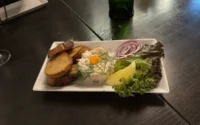
The skagen starter we had on the Stockholm Food Tour was too big (we shared two plates of it among eight people). The server today recommended a herring starter as something smaller.
I can’t say I’m a major herring fan. That is, I could say it, but it would be a lie. Nevertheless, the herring was fantastic. There were three servings in little tasting dishes, each with a different sauce. One was a mustard sauce, another a dill sauce, and the third was what the server said was a traditional Stockholm herring sauce, but he didn’t explain it further. All three were delicious.
The meatball dish was no different from what I described in my post about the Stockholm Food Tour, other than this time, despite being the same restaurant, I got four meatballs instead of three. Maybe they give regulars an extra one. Yum!
Discover more from Joel's Journeys & Jaunts
Subscribe to get the latest posts sent to your email.
Kungliga Slottet Royal Chapel, Museum, Antiquities; Plus a Boat Tour

Voyage to Drottningholm Palace
I love those little guys in Goose Square. They are too adorable to be the type to actually be angry with each other. The next move would probably be to hug each other while hopping up and down. The buildings around the square look like historic inner city tenements of the type one sees in Edinburgh. It indeed makes for a charming little square. Lovely views across the water, even if the sky is lowering, showing you more parts of Stockholm worth visiting, and time is so short! The nobles’ hall was noble, and it was noble of them to let you in. Clever of you to find your way back to delicious food. Just the sort of homing device we were implanted with from birth.
I like your story about the statue in Goose Square. Most of Stockholm is great.
Still lots to see. Goose Square, for example. Thanks for giving us a gander. About Riddarhuset: its opulent spaces, chandeliers, ornate ceilings, and wall-to-wall rogues’ gallery look nothing at all like the annual IKEA catalogs and showrooms I’ve explored over the years. Opposite ends of the Swedish decor spectrum, huh?
Bravo on goosing up your reply with the gander pun.
Strangely, I didn’t see a stick of IKEA furniture in the palace’s and House of Nobility that I visited.