Gamla Stan Again (German Church & Judiska Museet)

“Gamla Stan Again (German Church & Judiska Museet)” was not supposed to be the title of this post. It was supposed to be “Medeltidsmuseet.” I’ll get to that in a moment. But first, a brief tangent.
The problem with publishing three posts in a day, rather than my usual two, is that by the time I write the third, it’s getting so late and I’m so tired that I tend to rush through it. Consequently, there are probably even more typos here than I usually make, a high bar though that may be to jump over. And it’s likely not as detailed as I would like. You might suggest that I put off writing it until tomorrow. However, by tomorrow, today is usually a blur for me. So if I don’t write it now, I won’t write it at all. I’m not sure if anyone would mind that, but here we are.

(In case you’re not following along, my morning post today was about a visit to Stockholm’s Moderna Museet. My midday post was about a Stockholm Archipelago cruise I took.)
About that change in the title I mentioned above, when I got off the Stockholm Archipelago tour, I didn’t know what I was going to do for the rest of the afternoon. I sat on a bench and looked at my guidebook and walking tour app on my iPhone to try to find something nearby. What I found was Medeltidsmuseet. It’s a Medieval history museum.
I seem to recall going there and appreciating it during my visit to Stockholm over a decade ago. In my memory, something I don’t entirely trust, or even trust much, the museum was located on a small island connected to a bridge between Gamla Stan and central Stockholm. As I’ve been walking around Stockholm for the past few days, I kept my eye out for it. But it wasn’t on the top of my list, so I hadn’t checked a map to find out where it was.

When I looked at Apple Maps, it showed me that it was on a small island by a bridge to Gamla Stan, just as I remembered. But when I got close to it, and saw where it used to be, there were no signs out front and the door that was there looked very much closed and uninviting.
So I switched to Google Maps. I showed it was at a different location, deeper in the Gamla Stan. It’s just across a very small courtyard from the side of Stockholm Cathedral, which I visited on the day I arrived in Stockholm. When I got there, there was a sign that said it was just a pop-up Medieval museum, not the full museum.
I went inside what was a small area, probably not that much bigger than the living room/dining room in my not very large condominium. It looked more like a souvenir shop than a museum, and a small souvenir shop, at that. I think the small structure was attached physically to the Nobel Prize Museum’s structure.
I asked the one staff person there if this was the Medieval museum. She said, “Yes, this is it for now.”

They closed their old location and are going to be moving into what is now the Nobel Prize Museum. The Nobel Prize Museum is building new premises, and the Medeltidsmuseet can’t move in there until the Nobel Prize Museum moves out. She didn’t know when that would be.
Man, the DLJSSIA (Don’t Let Joel See Stuff International Association) takes its mission seriously here, doesn’t it?
Since I was already in Gamla Stan, I decided to walk around there more because who could possibly get enough of Gamla Stan? Not me. It’s beautiful.
I wandered the streets aimlessly, and loved them every bit as much as I always have, but I stumbled on a couple of buildings that drew me in for various reasons, the German Church and the Judiska Museet.
The German Church

I’d passed the German Church in Gamla Stan before. It looked interesting. And the guide on the Stockholm food tour I took a few days ago pointed it out. But I’ve never been inside. I decided to change that.
It’s a lovely little church. Of course, I didn’t pull out a measuring tape, but I think it’s roughly square rather than the rectangular or cross shape that you expect from churches.
There are some very vibrant stained glass windows on all four walls. The one on the back wall and a couple on the front wall, along with a few on one of the side walls, are all of religious scenes. But on the other wall, there are a few stained glass windows of family life themes that didn’t seem particularly religious. Although, above a balcony, above those family-themed stained glass windows, were some smaller, peaked stained glass windows that did have religious themes.

Along the wall of the balcony, there are some small religious paintings.
Oh, and what is there behind the pulpit of the German Church? The same Hebrew letters as on the ceiling of the church in Skansen and the pulpit in the Stockholm Cathedral. In a reply to my post about Stockholm Cathedral, after a friend did some research on the interwebs thingy to find a higher resolution picture than the one I posted, she told me it’s the Hebrew word, “יהיה. Yud hay yud hay: i.e., Jehovah.”

Germans have lived in Stockholm for a long time. In 1571, King Johan III of Sweden granted Germans in Stockholm privileges. Those privileges were later renewed. In 1607, the Germans were given a chapel that they had shared with a Finnish parish. It became the German church that stands today, although it has been extended a few times since then.

Judiska Museet

As I was walking around Gamla Stan, I saw, first, a sandwich board sign for Judiska Museet, then a small sign by the door of the museum. I probably don’t have to look up the translation of Judiska Museet for you to figure out it’s a Jewish Museum.
Judiska Museet is very small. It’s in what used to be a conservative synagogue. (Jews haven’t left Stockholm. There’s still at least one bigger synagogue in Stockholm. After the war, some Jews who survived the Holocaust were brought to Sweden. When the modern State of Israel was founded, some left to go there, but some stayed.)
As I said, the museum is very small. There’s not much there.

In the lower level, there was a temporary exhibit of photography by Anna Riwkin (1908 – 1970). She used her photography to chronicle Jewish life in Stockholm. But she also went to the British Mandate, and then to the State of Israel when it was founded and did considerable photography there.
Upstairs is where the synagogue used to be, and where the permanent exhibition is now. I repeat myself, but it is a small museum. There was some text in Swedish and English about the Jewish community in Stockholm and Judaism in general.
According to the text, the first Jew to arrive in Sweden to be granted rights to practice his religion was Aaron Isaac, in 1774. According to the sign, “In the early nineteenth century, Jews were eager to fit in. Swedish society did not make it easy for them, however. It was made crystal clear: come to Sweden, but do not expect to be included.”

There’s a small balcony upstairs in what I assume used to be the women’s gallery in the synagogue. Up there, there’s a collection of kippahs. A sign there mentions that kippahs go by many different terms: “Kippah, skullcap, yarmulke, koppel.”
After leaving the Judiska Museet, I took an intentionally non-direct route back to my hotel to spend a little longer in Gamla Stan.
More pictures below of Gamla Stan streets, because there’s no such thing as too many pictures of Gamla Stan streets. (I have more if you’re interested.)


Discover more from Joel's Journeys & Jaunts
Subscribe to get the latest posts sent to your email.

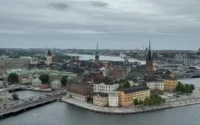

I very much approve of Gamla Stan’s taste in colour – all that lovely yellow and orange. It is an attractive cityscape. Very inviting. It is a shame about the medieval museum. I think I might have enjoyed hearing about it. However, good that you found the Jewish museum to round out all the churches, impressive as they are. Sounds like a very full and enjoyable day in Stockholm. Thanks for staying up late to finish telling us about it.
Gamla Stan is warm and inviting. There are a lot of tourists, and probably even more when the high season officially starts, but they tend to stick mostly to a couple of main streets. This tourist likes to wander the smaller, quieter streets.
It was a good day.
It’s a benevolent DLJSSIA that allows you more time to amble in the cobblestone streets of Gamla Stan. Buildings painted marigold, melon, honey, and mango make for deliciously upbeat atmosphere. You discovered the German Church, where peasants and saints alike are rendered in stained glass and where the now-familiar Hebrew language theonym (yud hay vav hay) appears yet again for you to espy. Finally, the fates deposited you at the Judiska Museet. I knew a handful of Holocaust survivors who as young women were rehabilitated in Sweden in the wake of the Second World War, and later dispersed to the US, pre-state Israel, and Australia. Sweden notably gave haven to the Jews of Denmark, more than 7500 of 8000, hidden by the Danish resistance in October 1943 and smuggled on fishing boats in a 3-week period to its neutral shores. (The reality of Sweden’s declared neutrality in the first years of the war is worth reading about.)
I’m thrilled that the DLJSSIA was little active in Gamla Stan. I love Gamla Stan.
I knew about Sweden giving shelter to Danish Jews during the war. About a decade out so ago I was in Copenhagen and Stockholm. In Copenhagen, I went to the Jewish Museum. It told the story of the Jews there during the war.
Surprisingly, I remember a lot of the story (but absolutely none of the numbers or dates.)
When Germany successfully invaded Denmark, Denmark did a deal with the Nazis to spare its Jews. Later, the Nazis decided to break the deal, but they gave the Danish authorities a warning that they were about to round up their Jews. The Danish authorities warned the Jews in their country and got the vast majority into them still officially neutral Sweden.
If I remember correctly (and I might be misremembering this part) the Danes managed to arrange less-harsh detention for those Jews that didn’t get out and were rounded up.
The upshot is that the majority of Danish Jews survived the Holocaust. I’ve had a particularly soft spot for the Danes since visiting that museum. Damn. Now I’ve got to go back to Copenhagen.