Nagoya Aquarium
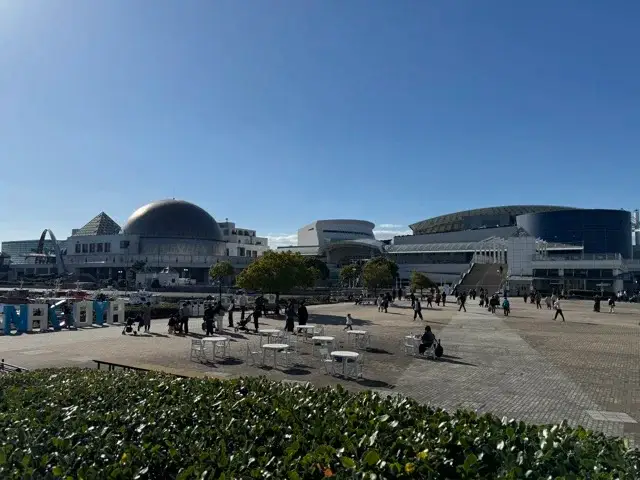
Officially called the Port of Nagoya Public Aquarium, the Nagoya Aquarium is, unsurprisingly, located by the Port of Nagoya and is open to the public, provided they pay the entrance fee.
What the name doesn’t imply, but is true, is that it’s located among a few other attractions, making it a good place to start the day before deciding if I wanted to see the other sights.
I left the aquarium a tad before the earliest time I normally have lunch, so I took in another attraction before my midday repast, the Fuji Antarctic Museum.
Nagoya Aquarium
The Nagoya Aquarium has two wings. I think they’re chicken wings, but they could be pheasant or duck. I’m not an ornithologist.
No, I’m mistaken. They were buildings, not those sorts of wings. And they bore no resemblance whatsoever to those sorts of wings.
I don’t know why you people put up with my horrible puns. Then again, exceptionally few people do. Maybe there’s a reason for that.
The two Nagoya Aquarium buildings are separated by a long corridor. So there’s no need to go outside unless you want to go to the stadium. I did.
Jellyfish
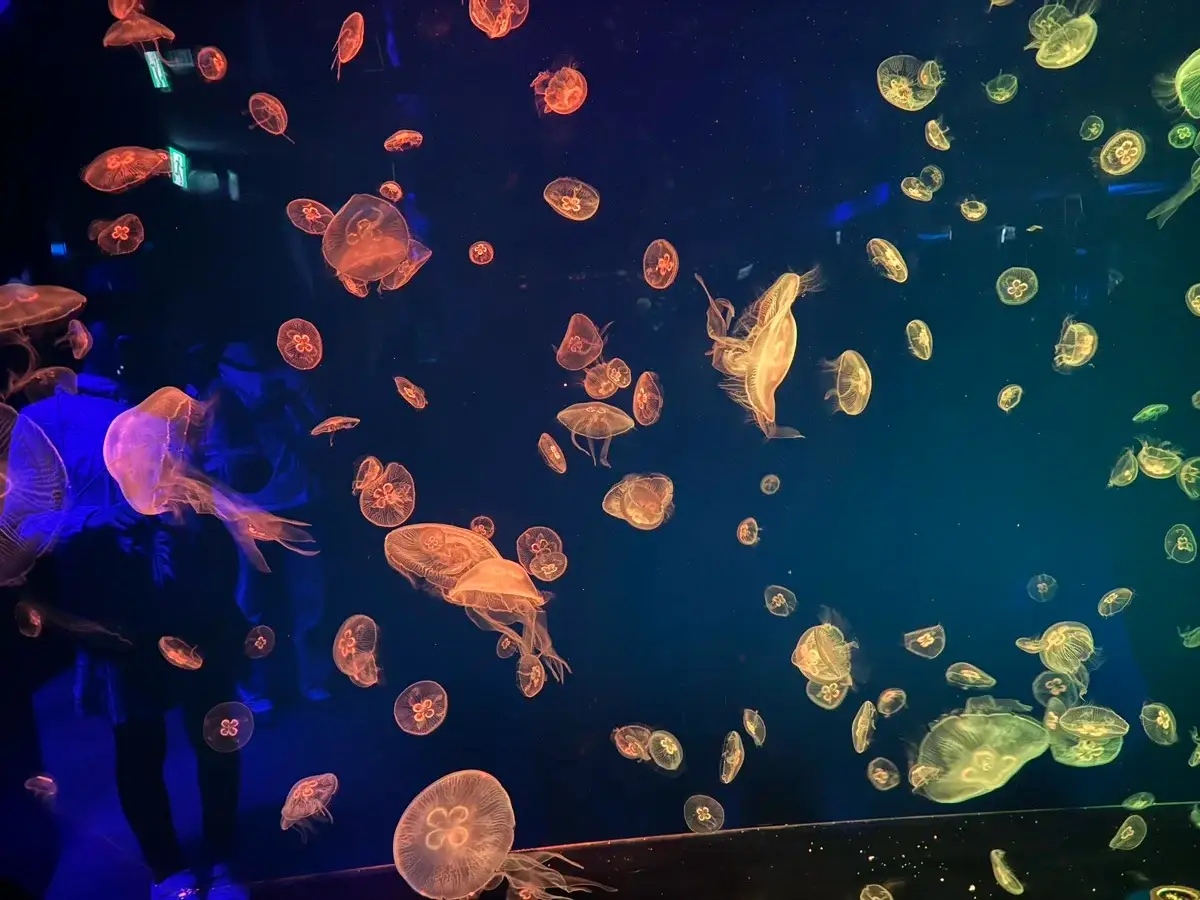
I’ll get to the stadium soon, but let’s get this out of the way up front: despite my not seeing them until just before I left the aquarium. Yes, yes, they do have jellyfish!!
The room with the jellyfish tanks was hard to find, but I found it. It wasn’t the largest jellyfish display I’ve ever seen at any aquarium. But it wasn’t the smallest, either.
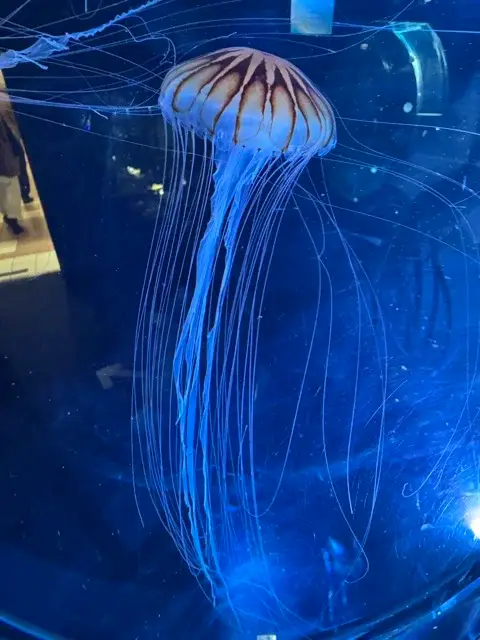
Regular readers know how much I love looking at jellyfish. New readers won’t. For the benefit of those new readers and any regular readers who have forgotten. This link will take you to a page of all posts that include a visit to an aquarium, provided I remembered to tag the post with “aquarium.” You can use the link to read or reread my repeated gushing over jellyfish.
One of the jellyfish tanks had a jam of jellyfish slowly swimming about in their unique way. The tank was lit, with the colour of the lights changing occasionally.
Regular readers might have noticed that I recently discovered a new technology. I think the kids call it “video.” I took a brief video of the jellyfish in that tank. Sorry about the loud child. It’s Saturday. There were lots of families at the Nagoya Aquarium today. You might want to turn the sound off before playing the video.

I hope that, now that I’ve discovered it, I don’t start to overuse this newfangled video thingy. (“Start,” some readers snort. “That ship sailed with your first video.”)
The Rest of Nagoya Aquarium
Surprisingly, aquariums don’t live by jellyfish alone. So, now that we’ve gotten the important stuff out of the way, let’s get on to the rest of it.
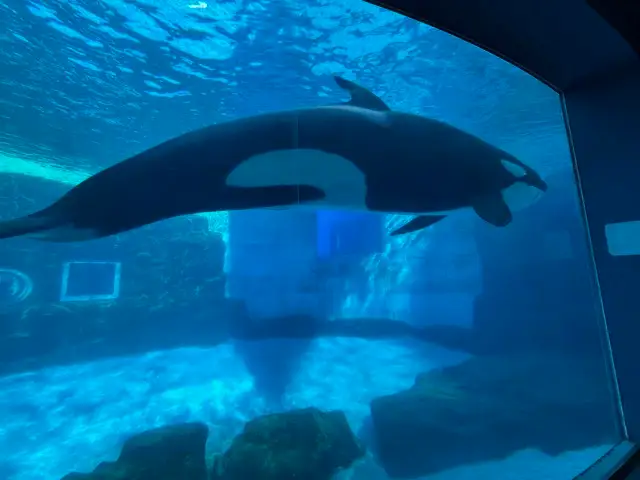
The first of the Nagoya Aquarium buildings is home to some larger beasts of the sea than you typically see at aquariums. To house them, the tanks are also larger than most aquarium tanks.
One held an orca whale. Just one. It was a large tank, but I don’t think it was large enough for the orca. It just did circles around the tank. It swam slowly, but took little time to complete each circle.

The same building also contains large tanks with a couple of different dolphin species and beluga whales, one species per tank.
It was also this building that has the stadium I mentioned above. The stadium is a large, deep pool, the top of which is outside. To one side of the pool, there are several tiers of stadium seating facing the pool. There is also a viewing area indoors, one level down, where people can watch the action underwater from behind a glass wall.
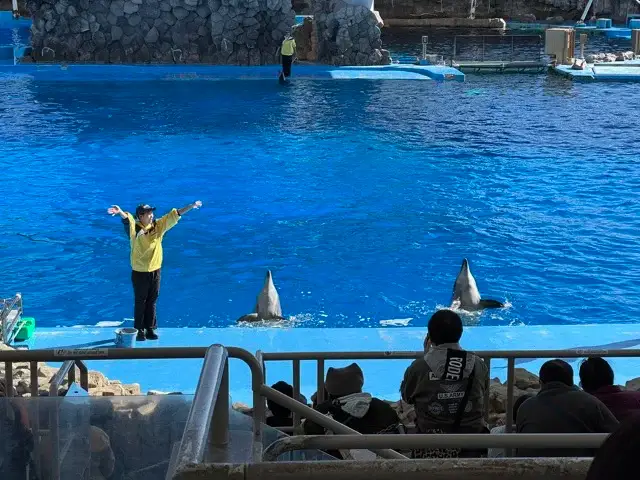
I chose the outdoor seating on this cloudless day. By coincidence, I happened to arrive at the start of a dolphin show. There were signs listing show times, but they were all in Japanese, so all I knew was that there was a show of some sort happening. But until the show started, I didn’t know what.
Before the action began, there was a live commentary by a woman who seemed quite enthusiastic. She stood on the audience side of the pool and spoke at length about the local cuisine in Nagoya, how it differs from other regional Japanese foods, and the best restaurants for each Nagoyan dish. Okay, probably not. But she spoke exclusively in Japanese. I don’t know what she said. So your guess is as good as mine.
On the far side of the pool, there was a giant video screen. While she was talking, the video on the screen occasionally cut to her, but mostly played videos of whales, with captions in both Japanese and English providing facts about whales. That might have been what she was talking about rather than cuisines. I don’t know.
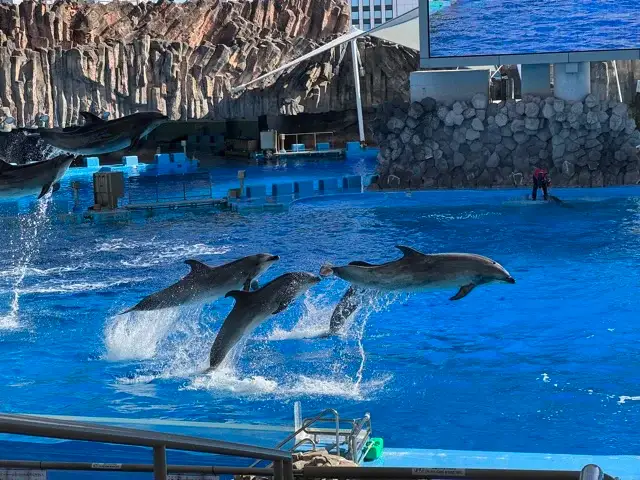
After she finished, it was the turn of the dolphins and their trainers. The trainers fed the dolphins a lot of fish, and the dolphins performed a lot of tricks. The tricks included spinning in the water, sometimes with heads up, sometimes with their tails up; swimming around the pool really fast; hopping up on the deck and wriggling around before hopping off; and, of course, leaping out of the water.
During the show, the screen displayed live shots of the action, both from above the water and some underwater shots.
It was a very impressive performance, but if I were a dolphin, I wouldn’t want to work that hard for a sushi dinner. Not that there’s anything wrong with sushi.
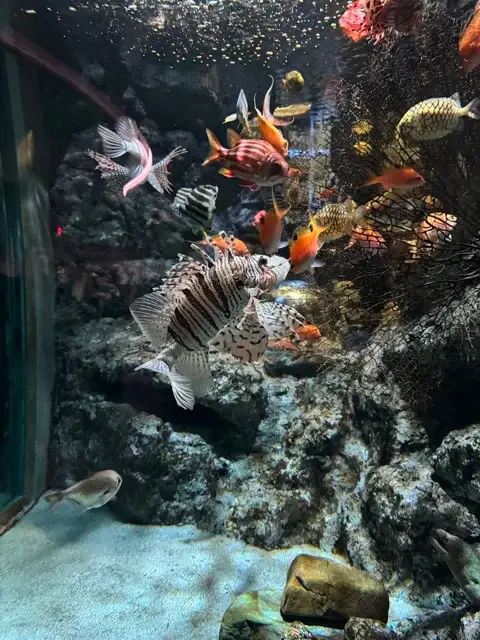
In the other building of the Nagoya Aquarium, the tanks were smaller, and the fish generally more tropical. In addition to fish, there were also several turtles and a species that’s definitely not tropical: penguins.
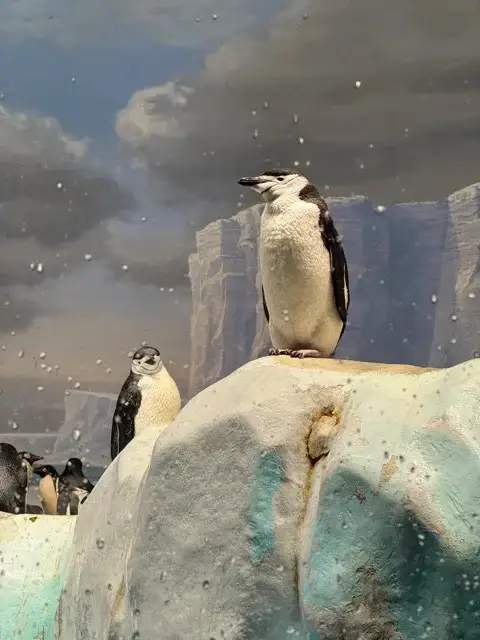
The penguin habitat had an above-water area designed to look like ice. There was also water for them to swim in, with a glass wall so spectators could watch them do so.
This was also the building where the jellyfish were, so that was the end of my visit to the Nagoya Aquarium.
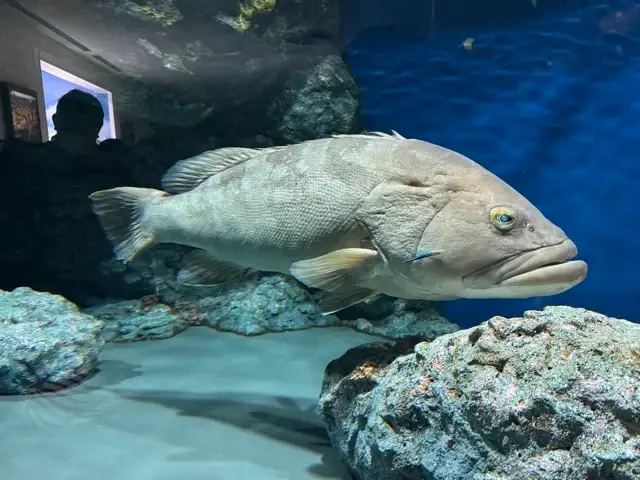
More pictures from the Nagoya Aquarium:

Fuji Antarctic Museum
The Fuji Antarctic Museum is just across a stubby inlet of water in the Nagoya harbour from the Nagoya Aquarium. The “Fuji” in the name of the museum does not refer to Mount Fuji, at least not directly. It’s the name of a ship, an icebreaker, to be precise.
There’s a good reason for the museum to be named after that ship. The ship is moored in Nagoya harbour, and the museum is in the ship.
The Fuji was Japan’s first icebreaker. That’s what the signage in the museum said.
If you search the web for “Fuji Antarctic Museum,” you’ll find a link to a Japanese-language page for it. There’s an “English” button on the page. If you click it, it takes you to the homepage of the English-language version of the Nagoya Aquarium’s website. There are blurbs on that page about the Fuji Antarctic Museum, along with the other attractions in the cluster.
I was able to buy a combination ticket for all the sites. So they might be part of the same organization. But that’s not why I mentioned the webpage. The blurb on the Nagoya Aquarium’s English page says that the Fuji “was Japan’s first genuine icebreaker.” The first genuine icebreaker? Did Japan have fake icebreakers that came before the Fuji? A real icebreaker. Accept no substitutes.
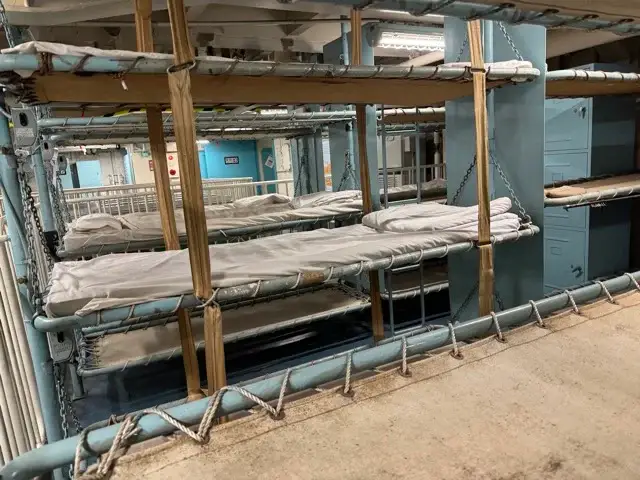
The Fuji was used for Japanese Antarctic exploration and was active for 18 years, starting in 1965. During its time in operation, the Fuji left Japan in the latter part of every November and returned at the end of every April.
The Fuji Antarctic Museum has visitors walk through the decks of the ship. At the beginning, there’s some introductory text in both Japanese and English. But some panels took a question-and-answer format. On those, the only English was a translation of the question, such as, “What are they studying in Antarctica?” The answers were solely in Japanese.
Walking through the ship, the rooms were labelled, and there was a brief text, I assume, about the function of the room. The name of the room was translated into English, but the rest of the text was solely in Japanese.
I have to stop at this point and make my usual point that I’m not criticizing them for the lack of English. This is Japan. The language here is Japanese. It would be presumptuous of me to expect that, of all of the myriad languages in the world, they are going to provide me with English translations of everything. However, if you come to Japan and don’t speak Japanese, you should know that you’re not always going to be catered to in English.
I don’t know how useful that information is to the world. First, there are the people who will never visit Japan. That information provides no value to them. But more than that, of all of the people who don’t speak Japanese but will visit Japan, 99.999…9 percent of them will never read a single page of this blog. So nothing I say here will ever be of any benefit to them. People who do read this blog would probably also say they don’t benefit from it, but I’d prefer they keep that information to themselves.
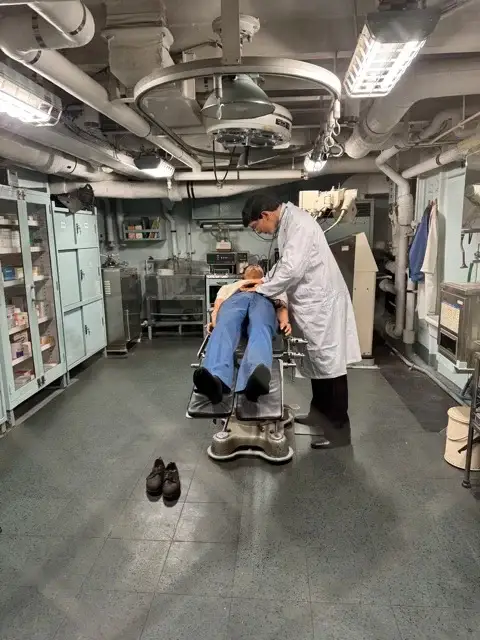
Many of the rooms on the ship contain mannequins depicting what people would do in those rooms when the Fuji was operational. For example, in the kitchen, mannequin cooks prepared fake food. In a barbershop, a mannequin barber cut the hair of a male mannequin. In the infirmary, a mannequin doctor examined a mannequin patient. And there were many more such tableaus.
That is to say, the mannequins were static. I had to imagine the action from their poses.
In the enclosed area of the upper deck, there was a museum with text panels in Japanese and English that presented information about Antarctica, the exploration and research of it, and, in particular, Japan’s involvement in Antarctic research, and the Fuji and the other ships Japan used in that research after the Fuji’s retirement.
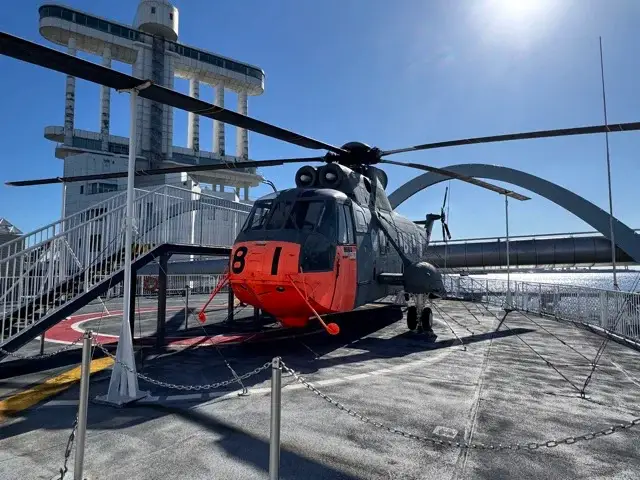
The helicopter that flew from the Fuji during its Antarctic voyages sits on the open portion of the upper deck.
The helicopter is by the exit from the Fuji Antarctic Museum. I arrived there when it was unquestionably time for lunch.
Discover more from Joel's Journeys & Jaunts
Subscribe to get the latest posts sent to your email.



An aquarium morning! How much better can things get? I enjoyed watching your jellyfish video. I am getting hooked on Joel television. I couldn’t help wondering, though, what the jellyfish think when the colours change all the time. Except they don’t have brains. Does it even make sense to ask what they feel about it? I can imagine the conversation in the tank: ‘Wow! Look at that colour! What do you think about this one? ‘ ‘I don’t know how to think.’ ‘Right-o. Wow! Get a load of THAT colour!’ Loved the big grey fish you showed us, and the tropicals were a splendour. Poor orca. I hope those dolphins are satisfied with their pay. They are doing a good job wowing us humans. No comment about our brains, or lack there of. That’s controversial. Thank goodness computers are taking over.
I knew you’d get a kick out of the aquarium.
I don’t expect Joel TV will get syndicated.
But, about the jellyfish’s brains, or lack thereof. Yeah, I don’t really want to get into that controversy either, but looking around, I often think that jellyfish are smarter than humans, or at least some humans. Probably me, for example.