New (for me) Nagoya
I moved on from Hiroshima this morning. I’m now in Nagoya, Japan. This is the last city of this trip before I head back to Tokyo to catch my flight to Toronto the following day to return home.
This is the longest trip I’ve ever taken, but it’s hard to believe that it is winding down. However, I still have three nights here in Nagoya. Let’s do this.
The Shinkansen (high-speed rail) train trip between Hiroshima and Nagoya took a little less than three hours, including a transfer at Shin-Osaka station. I could have done it faster, without a transfer, but I messed up my train reservation on this leg of my trip.
When I arrived at my platform, the electronic sign showed the yet-to-arrive train before mine. It was going all the way to Tokyo, with a stop in Nagoya. I have a Green Car JR Pass. Green Cars have a bit more legroom than regular cars, but you have to have a reservation to use a Green Car.
Most Shinkansen trains, except for some super-express ones, have a few cars that don’t require seat reservations. There were unreserved cars on the train before mine. I suppose I could have not used my reservation and boarded one of the unreserved cars on that train instead, but I didn’t. Why? Two reasons: One, I paid extra for the Green Car JR Pass, and I had a green car reservation, dammit. And, two, I’m an idiot.
When I travel, I always try to avoid connections. I get very nervous about missing them.
I thought I knew how I missed the direct route to Nagoya when I booked my reservation. Trains on Shinkansen lines are very frequent. The reservation site requires that you specify the time you want to leave. It then displays only the next two or three trains going to where you want to go, starting from that time. It includes routes with connections in those two or three listings.
There’s no “previous trains” or “next trains” button that I saw when making my reservations. And I looked for one carefully. If you’re unhappy with the two or three options provided, I think you must perform a new search, which is a bit of a pain.
My train was at 10:33. The previous train departed before 10:30. When I saw the previous train on the board, I figured that I must have chosen 10:30 as my preferred departure time, and the two or three options the system provided all required a change, so I picked one.
I figured that, but no. When the train after mine appeared on the board, the sign showed it was going to I forget what city, not Tokyo, but with a stop in Nagoya. So, I simply missed the fact that I could have picked an option without a connection.
The important thing is that I got to Nagoya, and it didn’t take all that much longer to do so. The fact that I missed the non-connection option because I’m horrendously unobservant and a complete idiot is secondary to that.
(It didn’t take all that much longer because my connection time was only 19 minutes. This didn’t worry me as much as it might elsewhere. A lot; just not as much. Every Shinkansen train I’ve taken on this trip, and when I was in Japan seven years ago, has been precisely on time. That seems incredible to someone who lives in Canada and has travelled on Via Rail, Canada’s passenger rail, several times. On Via, if a train is less than 15 minutes late, it’s considered to be a miracle and proof-positive that there is a god.)
All that boring introduction having been said, here I am. In Nagoya.
Nagoya Castle
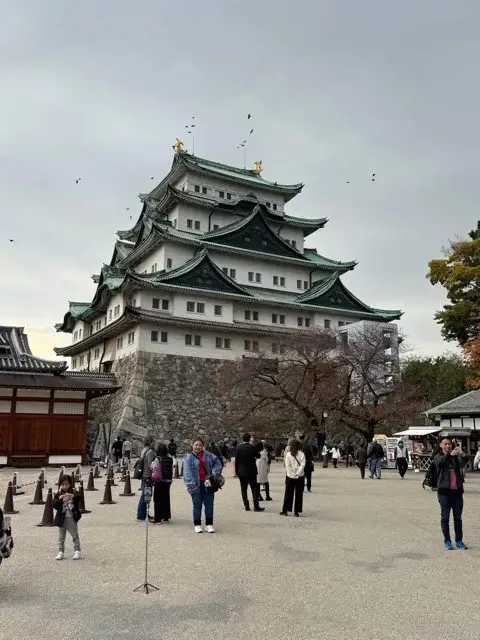
Another Japanese city, another Japanese castle. After settling into my hotel, I got going again and headed to Nagoya Castle.
A brochure available at the castle says that Nagoya Castle was essentially complete in 1615. The castle’s website says that the main keep, the castle’s tower, was already finished by 1612.
Hommaru Palace, which is in the castle compound, was completed in 1615.
There are also two watchtowers at the corners of the castle compound that were built within that period, and a third that was built just four years after the palace, in 1619.
In 1930, the Nagoya Castle towers and associated buildings, including the palace, were designated as a Japanese national treasure for their architecture. The brochure says they were the first ever to receive that designation. In 1945, they were gone, destroyed by firebombs in air raids during World War II.
The buildings there now are recreations of the originals.
Here’s a fact I knew before I visited the castle: Since 2018, the public has not been allowed in the castle’s tower or other keeps. The buildings were damaged by an earthquake that year. Despite still standing and, therefore, being available to be admired from the exterior, even getting close to the buildings, they were deemed unsafe for the public to enter.
(Thank you oh, so very much, Nagoya Castle, for reminding me that I’m currently in a highly seismically active zone.)
Viewed from outside, the tower of Nagoya Castle is grand. It’s a multi-tiered structure with white walls and green roofs on the tiers. The roofs are fringed with black. Between two sets of the tiers, some triangles jut out a bit. The fronts of the triangles are black. Their roofs are green. Its totality forms a striking image.
As I reread the preceding paragraph after writing it, I realized that I didn’t understand some of what I wrote. And there’s no way I could form an accurate mental image of the Nagoya Castle tower based solely on my textual description of it. That’s why the cellphone god gave us cameras in our phones. You can look at the picture I posted.
There is a moat around the castle compound, but on the side I entered, which I think is the only entry, the moat was dry, with greenery growing on its floor.
Hommaru Palace
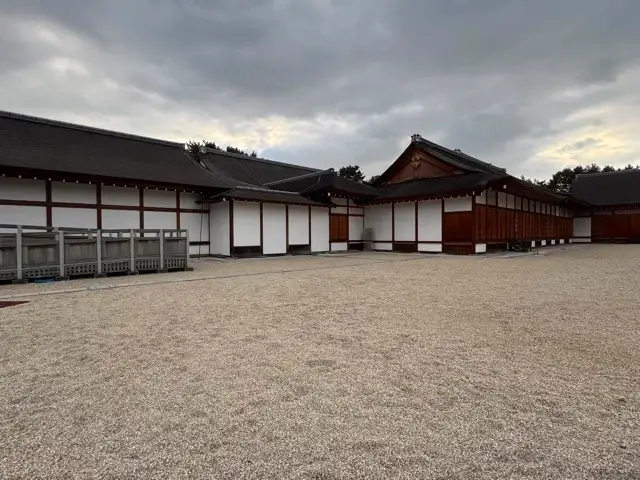
The recreation of the Hummaru Palace is open to the public to tour. In my opinion, from the outside, it’s not much to look at. It’s a low-slung white building with a black roof. To my eye, the building looks more like a barracks than a palace.
The interior, however, is beautiful in an understated way.
Before entering the main part of the palace, you have to take off your shoes and put them in a lockable cubbyhole. You use any cubbyhole with a key in it, put your shoes in, remove the key, walk through the palace on the designated route, and then put the key back in and retrieve your shoes. They provide slippers for anyone not wearing socks. I was wearing socks.
Visitors walk along a set path in the hallway that hugs the perimeter of the buildings. All of the rooms open onto that hallway with sliding doors that were open so visitors (paying customers) could see in. It looked like all of the rooms connected directly to the adjoining rooms with sliding doors between them. Most of the sliding doors between rooms were closed.
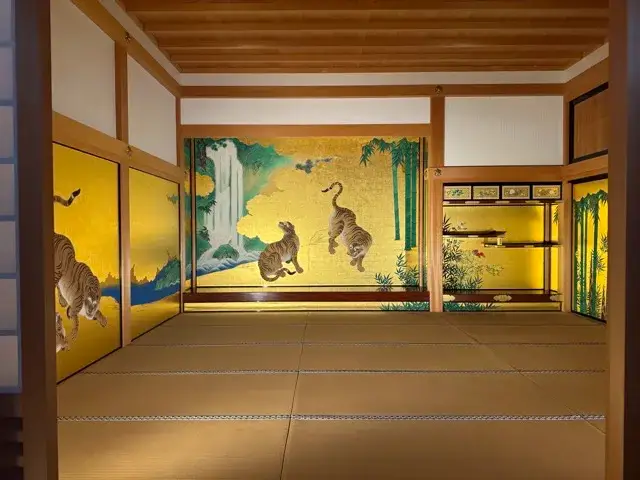
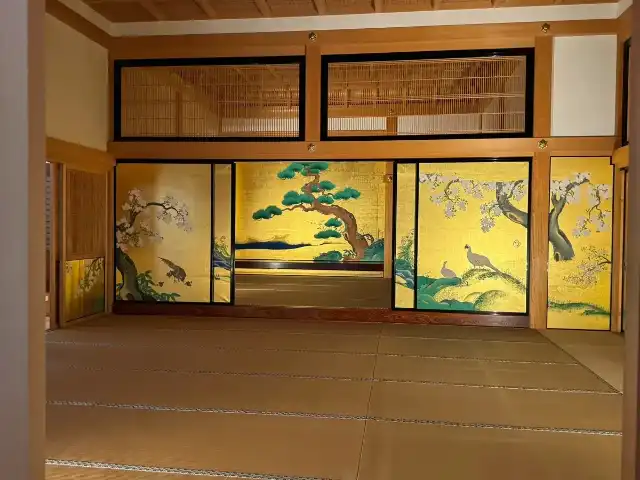
All of the rooms had murals on the walls. The murals were different in each room. Common motifs were trees, landscapes, and buildings. The colours were, for the most part, muted except for some dark green on trees, but gold predominated in the backgrounds. In some of the rooms, vibrantly coloured relief decorations sat above the murals.
As soon as I saw the rooms, I was strongly reminded of Ninomaru-goten Palace in Kyoto’s Nijo Castle. No, that’s a lie. I was strongly reminded of some building that I’d seen on this trip, but for the life of me, I couldn’t remember what or where it was.
I spent an inordinate amount of time looking for it. I did searches on this blog for terms like “palace” and “murals,” but when I opened the returned pages, I didn’t see any pictures of similar rooms. Then I remembered that some of the rooms in the other place had murals with tigers in them. So I searched for “tigers.” Same result. (The murals on the walls of a couple of the rooms in Hommaru Palace also had tigers.)
Finally, I remembered that the murals were noteworthy because tigers aren’t native to Japan. The artists had painted them from sketches and tiger hides that had been imported into Japan. I remembered having noted that in this blog. So I searched for the word “hides.” How often could I have used the word “hides” in these pages?

Nijo Castle kept coming up in my searches, including in the search for “hides.” So I decided to reread the post rather than only looking for pictures. I’d forgotten until I reread it that they strictly forbade pictures in Ninomaru-goten Palace. Hence, there weren’t any pictures from inside the palace in that post.
In Hummaru Palace at Nagoya Castle, on the other hand, they specifically said that photographs were allowed as long as you don’t use a flash. Therefore, I took pictures. So, if you want to see what the rooms in Hummaru Palace looked like and get a very general sense of what the rooms looked like in Ninomaru-goten Palace, look at the pictures here.
I said “looked like” rather than “look like” because, remember, the palace and the rest of the buildings of Nagoya Castle are recreations. A sign in the palace said the murals are close to the originals and were based on photographs taken and drawings made of the murals before they were firebombed.
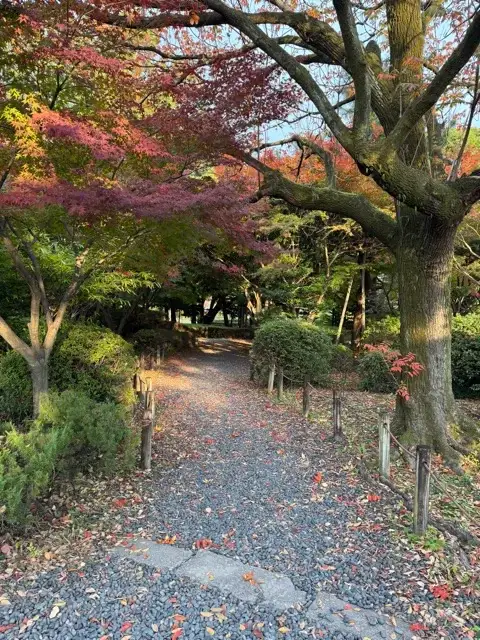
Ninomaru Garden
Ninomaru Garden is a beautiful garden in Nagoya Castle. Its trees, rocks, and shrubs are lovely, made all the more lovely by the bright red, orange, and yellow leaves at this time of year.
I think there might normally be a pond in Ninomaru Garden. At least, I saw one on a map. But I didn’t see one today. Maybe I just missed it. Sometimes, I don’t see plainly visible, large objects that are immediately in front of me. I did, however, see a large construction area. I didn’t compare its location to where the pond was on the map, but I think the pond might have been there.
This is not to say that the garden didn’t have a water feature. Off to one side of it is what I think might have formed part of the castle moat at one time, but it had water in it at this side of the castle.
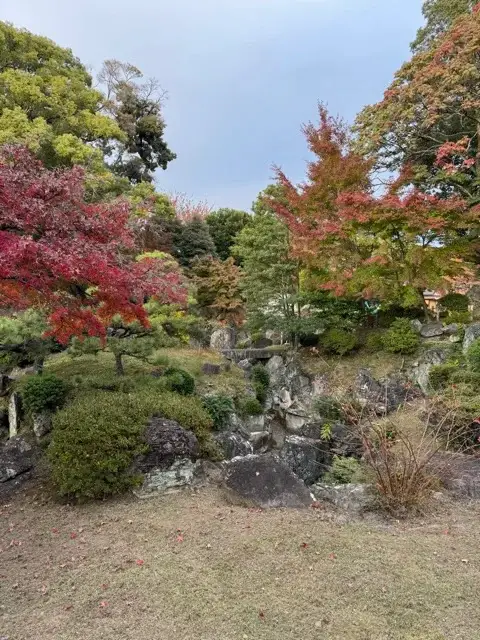

Meijo Koen Park
Meijo Koen Park is a nice spot with a large, generally L-shaped pond, but with a rounded corner and some bumps in its shape. A lot of the trees around the pond had lost a good portion of their leaves. They covered parts of the ponds.
The park has some other treed areas as well. The fall foliage makes them even more attractive at this time of year. There was one section where there was a bed of flowers among the trees.
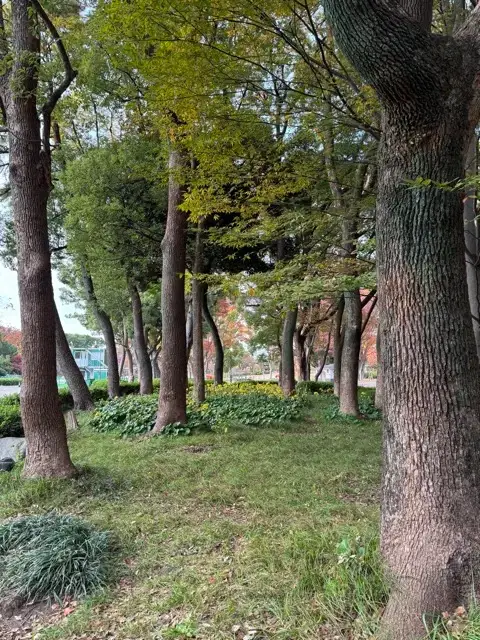
There are also sports playing fields and a playground there.
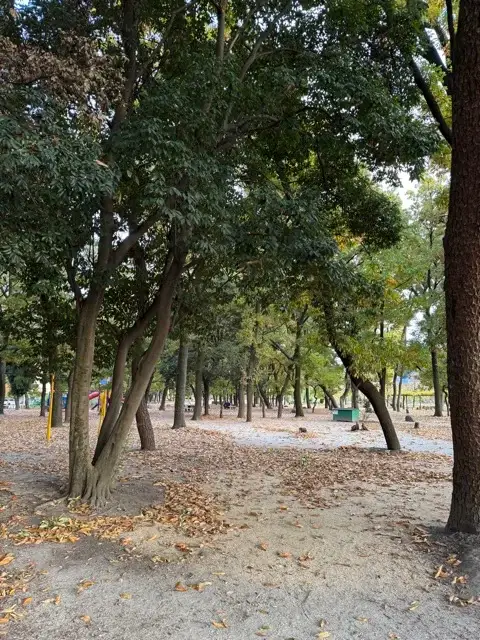
Thanks for All the FIsh
I didn’t see fish in the pond in Meijo Koen Park, but I made up for it on the walk back to my hotel. The route took me around the back of the castle. There, a sharply L-shaped moat that wraps around two sides of the castle had water in it. After walking along both sides of that L, I saw where the water-filled part of the moat joined the dried-out adjoining L-shaped portion. I don’t think there’s a dam to keep the water out of the dry section. I think the dry section simply has a higher floor than the section with water.
None of that has anything to do with why I introduced this topic.
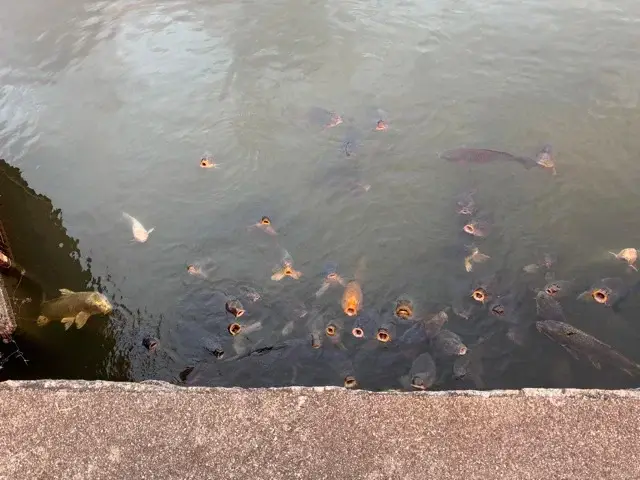
When I got around the corner of the L, I looked down in the moat and saw a bunch of koi. When they spotted me, most of them lifted their heads out of the water with their mouths open in a large oval, almost a circle. They held that pose until it was clear I had nothing to feed them.
A couple walked by while I was still there. They leaned over and looked in the moat. The fish did the same thing for them. I guess people feed the fish, and the fish have come to expect that people equals food. I felt guilty about not having anything for them. Then again, neither did the couple. So, the fish had three people to be angry at, not just me.
Discover more from Joel's Journeys & Jaunts
Subscribe to get the latest posts sent to your email.
Higashiyama Botanical Gardens

Shirotori Garden and Sights Before That

I hope those fine, frenzied fish weren’t famished. I suspect they aren’t. They just need to eat fish food, not your food. Better that way. Try to convince our dog of that simple truth, however. Just look at their little eyes, Joel. The expectation, the hope…. The palace looks lovely. Seeing the lovingly reproduced versions is bittersweet, however. So much destroyed by wars. Nice that you topped it off with the peace and solace of a sweet garden in autumn. About the train ride. Of course you take the reserved, more luxurious seats. The alternative is the scramble of an unreserved car. The consolation is that it could have been a misery. Faster and more convenient, but with a dollop of misery. But then again, with worries about connections and self-castigation for not checking train reservations closely enough, your dollop of misery comes along with you, doesn’t it? Your little companion. At least you don’t have to carry an extra suitcase or buy another ticket for it. Just a little rain cloud up there with your name on it that decides to relieve itself on you every now and again. Oy.
I’ve never before seen fish that can stand upright with their heads out of the water and their mouths wide open for so long. It broke my heart to not have any food for them. Maybe if I spent more time with your dog, I’d be used to it.
The reproduced palace is lovely inside and well worth a visit. The exterior? Meh.
The Green Cars aren’t particularly luxurious. There’s no food. They just have a bit more legroom. It probably wasn’t worth the extra cost.
Misery is part of the great circle of life. Life might be better as a triangle.