Closing off in Korea: Seoul Museum of History & More
After more than three and a half weeks in Korea, this is it. I’m heading home. It’s been a great trip. There’s a summary of my full Korea trip down below, along with a separate summary of just my time in Seoul.
But my flight isn’t until the early evening. So I had some time for more sightseeing today.
Let’s start with that, shall we?
Seoul Museum of History
I did a fair bit of exploring in Seoul on this Korea trip. I thought it was time to learn a bit about its history. Fortunately, the Seoul Museum of History was easily doable in the time I had.
It took me about 40 minutes to walk there, but I figured that with more than 13 hours of sitting on a plane ahead of me, the walk would be a good idea.
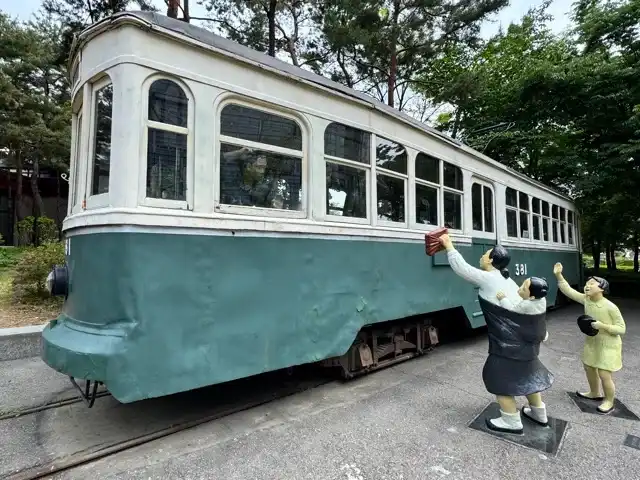
On the grounds of the Seoul Museum of History, not far from its entrance door, sits an old streetcar. Outside the streetcar, there’s a mannequin of a woman. She’s holding out a package toward a window. There’s a baby in a carrier on her back. Beside her, there’s a child mannequin waving at a man inside the streetcar that the woman was thrusting the package toward.

Inside, there’s a mannequin who’s the man the child is waving at. He has a look on his face that seems to be a cross between pain and surprise. Apparently, the package is something he forgot to take.
Beside him is another male mannequin who seems to feel the man’s pain.
Beside the streetcar, there’s a bilingual sign. It says, “This streetcar is one of the last two surviving streetcars in Seoul. It was moved to the Seoul Museum of History in December 2007.” And there it sits to this day.
But the streetcar is not all there is to the museum. There’s a whole indoors.

Two small, old stone statues, mirror images and looking at each other greet visitors as they enter. Quoting a sign in front of one of them, “Haedori and Haesuni represent Haechi, the symbol of Seoul. The Haechi is an imaginary animal believed to ward off evil spirits, discern good and evil, and deliver joy and good luck to those around him.”
I was thrilled to have joy and good luck at least while I walked into the museum and paused briefly to take Haedori’s or Haesuni’s picture. (I don’t know which. All Haechis look the same to me.)
The museum isn’t huge, but it covers a lot of ground, at least rhetorically.
The permanent exhibits are all on the second floor. There is a temporary exhibit space on the first floor, but the exhibition that was on now looked like it was for young children.

The exhibits are divided into four zones, covering eras chronologically. The first zone presents 1392 to 1863, the establishment of the Joseon capital, in what is now Seoul. The last zone covers more recent history, up to 2010.
Today I learned a lot of information about Seoul. I made notes on some of it. The rest I unlearned (forgot) almost as soon as I learned it.
One thing I learned is that the population centre that is now called Seoul wasn’t always called that.
When King Taejo established it as the Royal Capital in 1394, it was called Hanyang. During the Japanese occupation of Korea (1910-1945), it was called Gyeongseong. It became Seoul only after that. There might have been another name or two during Seoul’s history. I’m unclear on that.
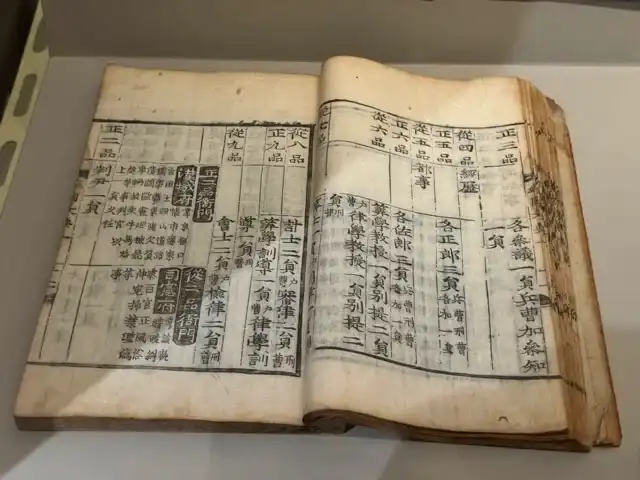
Speaking of the Japanese occupation of Korea, it altered what is now Seoul, including erasing some of its physical heritage. According to a sign, “The direction of and priorities for developing the colony were determined based on Japanese needs. Japan’s ruling colonial ideology was reflected in spaces of Seoul. Streets were altered to accommodate Japan’s military objectives and economic requirements, and structures symbolizing the Joseon Dynasty and the Korean Empire were demolished. In ruling and managing Seoul, Japanese residents were the priority. Traditions, colonial urban planning, and autonomous changes by residents all converged to create the unique features of Gyeongseong as a colonial city.”

(Having quoted that text, I’m conscious of the fact that it was likely written and edited by Koreans. I don’t know if it would say the same if it were composed by one or more Japanese people.)
Artifacts on display include pottery fragments, porcelain, decorated boxes, an old saddle, maps, documents, paintings, small-scale models of portions of the city at a couple of different times in its history, and much more of varying vintages.
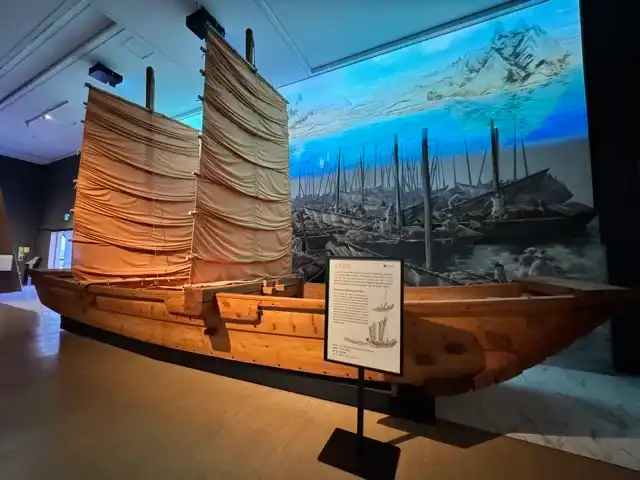
Falling within the “much more” items is the replica of an old two-masted, wooden sailing boat that’s new, but built using traditional techniques.
Also on the second floor, there’s a large, double-height room. On the floor of that room is a large relief model of modern-day Seoul. A small portion of it has a glass floor, where you can stand and look down or across to the rest of the model. There is also a balcony for your viewing pleasure.
Three of the walls serve as floor-to-ceiling projection screens. Most of the time, there are patterns displayed on them. However, every half-hour, there’s a seven or eight-minute show on all three walls. At the start, there are illustrations and animations of old Seoul. Then it moves into video vignettes of different sights and cultural activities in Seoul as it is today. There was also a light show playing out on the relief model. The soundtrack was solely instrumental.
The one thing that annoyed me about the modern-day clips is that they made it plain to me that I’ve missed so much of Seoul. And I’m out of time here to see it as this Korea trip draws to a close.

And More
The Seoul Museum of History is to the side of a small but pleasant park. I sat on a bench there for a while.
But I didn’t just sit. The park is the site of the former Gyeonghuigung Palace.

A bilingual sign told me that it was one of the five main palaces of the Joseon dynasty and “was established during the reign of Prince Gwanghae (r. 1608-1623). and functioned as a major palace until the late Joseon dynasty during the reign of King Gojong (r. 1863-1907). Several buildings, including Sungjeongjeon Hall and Jajeongjeon Hall, used to be arranged along the geographical features of the palace. However, most of the buildings were relocated and reused in Gyeongbokgung Palace when Gyeongbokgung Palace underwent reconstruction during the reign of King Gojong. During the Japanese colonial period, the ownership of the palace was turned over to the Joseon Governor-General’s Office. Gyeongseong Middle School and official residences were then built there, destroying the palace’s dignity. The area of the palace was also considerably downsized, but with persistent excavation and research, a part of Sungjeongjeon Hall and some other buildings have been restored and remain to be what they are today.”
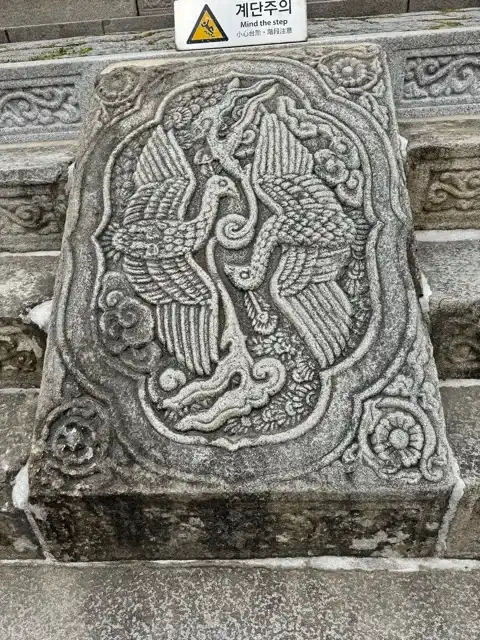
Some palaces get no respect.
The buildings that are there today are stately and handsome in an old Korean palace sort of way.
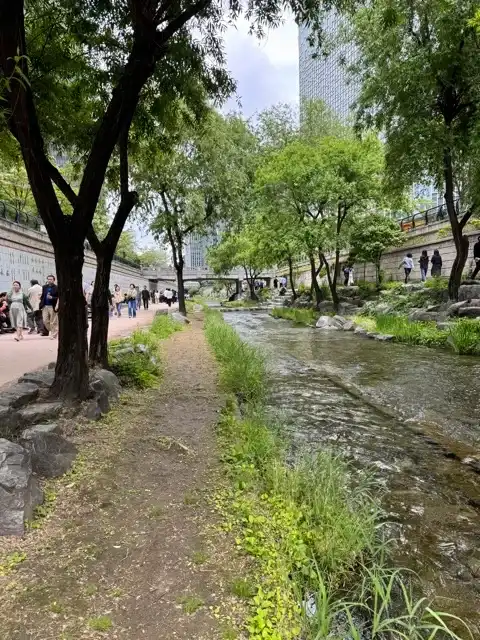
I still had a bit of time before I had to rush back to my hotel (I got a 2:00 p.m. checkout), finish my packing, and head to the airport. One end of Cheonggyecheon Stream, Seoul’s fabulously recovered stream, is not far from the palace. I loved the stream when I walked along it earlier in this trip. So I went back.
I had only about twenty minutes before I had to head back to my hotel. I made it to my hotel with almost fifteen minutes to spare before my checkout time. I would have been there much earlier, but I just missed two or three pedestrian crossing signals on the way back. (See the “Pedestrians” aside below.)

And that concluded my programming day and my journalized activities during this Korea trip.
Seoul Summary
Seoul, Korea, is a big, bustling city with lots of terrific things to see and do. Even with seven full days there, and then a half day on either side of the night before my return flight, I didn’t get to them all.
I don’t know that I could name one thing that stood out for me as the best. There are parks, mountains, museums, temples, aquariums, and vista points that are all worth seeing.
One absolutely brilliant thing that Seoul has done, which I’d read about before visiting the city and knew I wanted to see, is the Cheonggyecheon Stream that I mentioned above. It’s a natural stream, but for years it was first covered over with concrete and then had an overhead expressway built over it. They’ve since ripped down the expressway, torn up the concrete, and restored the stream with walks along its banks. And because it’s lower than street level, street noises are muffled somewhat, and you never have to cross an intersection as you walk its impressive length through the core of Seoul. Bridges go over it, so you don’t have to climb up and over the intersections.
Okay. Maybe I did have a highlight, but it wasn’t the only one.
I took one day trip out of Seoul to the DMZ. It was fascinating, but mainly in an iconic way. It is something I’ve heard about often for as long as I can remember, often in frightening terms, as the primary reminder of the never-officially-ended Korean War, but I had never seen. Now I have.
My guidebooks recommend a few other day trips out of Seoul that I didn’t take. And there are a few sights I know I missed because I didn’t have enough time. (Even more now that I’ve seen the show at the Seoul Museum of History.) So even though I spent longer here than in any other stop on this trip, I think I would have appreciated more time in Seoul. Maybe a few more days.
Korea Trip Summary
And now another trip has drawn to a close. It gave me one more country, South Korea, to add to the list of countries I’ve been to in my life. I found some of the cities I visited in Korea to be great. Others were overall so-so, but with at least one or two sights within them that made them more than just merely marginally worthwhile stops.
I started and ended the trip in Seoul. If you’re looking for a synopsis of my time there, shame on you for skipping to the end. It’s in the section immediately preceding this one. Please scroll back and read it above.
Jeonju
After my primary stay in Seoul, I journeyed to Jeonju. I enjoyed my time there. When I first encountered its most noted attraction, Jeonju’s Hanok Village, I thought it was over-touristy. But exploring it more deeply on a return visit to the neighbourhood, I found bits that were more traditional and less brash. It kind of grew on me.
But, for me, the best part of Jeonju, by far, was Wansan Park. The lushly forested mountain park would have been beautiful at any time of year, but by pure happenstance, I happened to be there when the park’s “flower hill” was at the height of its bloom of densely packed flowering trees. The hill was ablaze with vibrant colours and was outstanding.
The two and a half days (3 nights) I had in Jeonju were probably about right. I saw all of the sights that I knew about and wanted to see, without feeling bored by the time I left.
Gyeongju
My next stop in Korea was Gyeongju. As an urban centre, I was less than thrilled with Gyeongju. The streetscapes were on the mundane side.
But there are some interesting sights, including Royal burial mounds that rise as not-so-small hills (climbing on them is forbidden) in park settings. Speaking of parks, there are some attractive ones in Gyeongju and a pretty river to walk along.
Again, I think my time in Gyeongju—three full days—was about right. However, my guidebooks list some sights a little ways out that would have taken a bit of getting to, but I didn’t get to. If I had a day or two more in Gyeongju, I might have taken in one or two of them.
Busan
Next up was Busan, a coastal city in the south of Korea. It is very much a big city, but it has some beautiful parks, at least one very charming neighbourhood, and interesting sights. And there is the ocean to gaze at, including both beaches and rugged, rocky shores. Gorgeous.
I very much enjoyed my time in Busan. After my four and a half days there, I left wanting more, without even taking any of the possible day trips from Busan.
Part of the reason I left wanting more is that Busan is a very spread-out city, but it’s not urban sprawl for urban sprawl’s sake. There are a few mountains in the city that have to be worked around. Because of its wide expanse, getting between places you want to visit can take a while. And tourist sights aren’t tightly clustered in one area of the city. There are sights I didn’t get to see. If it weren’t for the travel times between sights, I could have seen and done more in the city.
The upshot is, at least a couple of days more in Busan would have been great. And it might have allowed me to take a day trip or two from there.
Andong
From Busan, it was on to Andong. I spent a half day there on the front end of my stay, and then two full days.
I neither loved nor hated the opening half day and the second full day, but if I’d done without them, it wouldn’t have lessened my enjoyment of my Korean trip.
The first full day, however, was terrific. I saw three sights that day—Hahoe Folk Village, World Mask Museum, and Byeongsan Seowon—and loved all three.
I probably should have skipped some of the activities I did on the other day and a half and found a day trip to take instead of them, or just spent less time in Andong.
Gangneung
My final stop on this Korea trip, before heading back to Seoul for one night ahead of catching my flight home, was Gangneung.
I spent only a day and a half there. That was a mistake. Maybe a big one. Gagneung has some beautiful parks, moderately pleasant streets, and exceptionally long sand beaches. I suspect if I had explored more, I might have found some rocky shores, which are by far my preferred way to view the interaction of sea and shore, but I didn’t leave myself enough time for that.
I really liked the city.
Plus, I think there are a couple of day trips I could have taken if I had the time. I didn’t.
In hindsight, if I didn’t want to expand my Korea trip to longer than it was (and, to be honest, as I sit at the airport finishing this up, I’m ready to go home), I probably should have spent a day less in Andong and shifted it to Gangneung.
—————————
And that brought me back to Seoul. I didn’t spend nearly enough time in South Korea to do more than just barely scratch the surface. There are places I read about in my guidebooks—particularly Jeju Island, well off the south coast of Korea’s mainland—that looked like places I’d like to visit, but I couldn’t fit them into the time I allotted myself for this trip.
And so, except for a couple of asides immediately below, that’s it for my Korea trip journal.
Aside
Driving
I don’t enjoy driving. At all. I live downtown and got rid of my car several years ago because I rarely used it.
When I travel, I try to avoid renting a car. There have been three trips that I remember in the last few years where there were places I wanted to see that were too difficult to get to and around in without a car, so I rented one for a portion of the trip. But it’s something I do reluctantly.
And I have a hard-and-fast rule about driving. I won’t drive in any country where they drive on the left side of the road. I’m a nervous enough driver, and not the best at it as it is. I’m convinced that I wouldn’t be able to drive on the left side of the road without smashing up within the first few blocks.
That’s not a problem in South Korea. Unlike nearby Japan (nearby for someone who had to travel across more than half of North America and then the Pacific to get here), they drive on the proper and right side of the road.
So, I could have rented a car. Perhaps I should have, because there are places that, based on my guidebooks, looked like spots I’d like to visit, but it was too difficult to do so without a car to be worthwhile.
Aside
Pedestrians
The cities I visited in Korea appear to have a love-hate relationship with pedestrians. They love to hate pedestrians.
In many places, it can be at least a few blocks between pedestrian crosswalks, signalized or not.
And on some of the particularly busy streets, they don’t just discourage jaywalking with pesky nuisances like laws; they make it impossible unless you’re an expert hurdler. They put metal pillar-and-post barriers, maybe a little more than average knee-height, between the two directions of traffic on those streets.
And if you want to cross a busy street on a crosswalk at a signalized intersection, bring something to do while you wait. If you just miss a crossing light, you’re going to be there a while until the next one.
What’s more, cars always seem to get priority at the signals. Always.
This is not just true in the bigger cities I was in, Seoul and Busan, but also in the smaller ones.
The worst was in Busan at an intersection a couple of blocks from my hotel. Pedestrians are totally barred from that intersection. There are no crosswalks there. The barriers between directions of traffic so tightly approach the intersection that if you (probably illegally) crossed without a crosswalk, you would have had to walk into traffic to do so.
There was no way to cross that intersection at street level without going a block or two or three out of your way, crossing, and then doubling back.
I wanted to go to a restaurant from my hotel that looked on the map like an almost straight walk with just one turn past that intersection. My mapping app told me, no, no, no. You have to enter at entrance x into the warren of an underground mall that is the subway station there (many subway stations in Seoul and Busan are like that), leave the warren at exit y, and then continue on your way above ground.
The restaurant was only a few blocks away. I thought the app must be crazy. I tried to find an above-ground route on the way back. I did, but it took me several blocks out of my way on what should have been a fairly straight route.
After that, I vowed not to have dinner at any restaurants that required crossing that intersection to get to them.
If Korean cities were more pedestrian-friendly, it would have made my trip slightly more pleasant, but it wasn’t nearly enough to turn me off Korea.
Discover more from Joel's Journeys & Jaunts
Subscribe to get the latest posts sent to your email.
Lotte World Aquarium & Tower

War Memorial of Korea; Seoullo 7017
Wow! I learned some fascinating things I did not know about Korea. A very helpful summary, as always. Nice to finish off the trip with the Seoul Museum of History to kind of round things off, but a bit frustrating too, as the more you found out, the more things you discovered you might have wanted to do. But you knew that you could not go to a country for three weeks and leave not having things you still want to do. There is a kind of sweetness to that, leaving while still having a taste for the place, no? I applaud your latest great adventure, and hope you are having safe travels home.
I’ll start at the end of your comment. I’m now on the train between Pearson Airport and downtown. I had a safe flight home. Surprisingly, I slept through much of it. The flight arrived early and the 13 hour flight felt much, much shorter.
Leaving Korea was bittersweet. I enjoyed my time there. If I live long enough and travel frequently enough, I could imagine going back one day and seeing more of it. So much world. So little time.
But, in truth, I was getting tired by the end of the trip and it was time to come home. I should learn how to just do nothing for at least a day or two of a long trip to recharge, rather than letting FOMO push me to see ever more sights.