Kirkstall Abbey & Museum (Leeds)
This morning in Leeds, England, I visited the ruins of Kirkstall Abbey. I then crossed the road. Why did the Joel cross the road? To see the small, only tangentially related museum there. That’s why.
To shake things up a little and add substantial excitement to my journal, I decided that I wanted to try something different with this Kirkstall Abbey entry. But I couldn’t think of anything. So I’ll plow ahead with my usual prosaic prose. Sorry about that.
Kirkstall Abbey
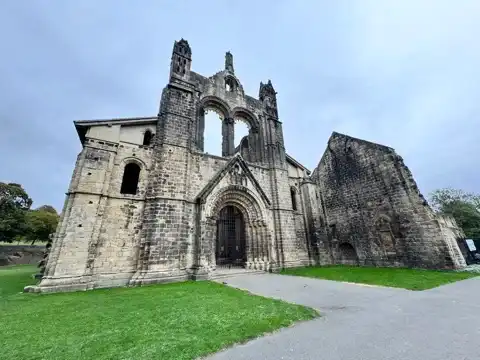
In 1152, Cistercian monks built an abbey, Kirkstall Abbey, in what’s now a suburb of Leeds, England. It expanded, changed and flourished for some time after that. Then, it closed in 1538 and fell to ruin.
After conservation work in the late 19th century, it opened to the public in 1895.
It’s nowhere near as complete as it once was. But considering that it’s about 800 years older than I am, it’s not in awful shape for an abbey its age. A few of the walls are completely gone. But substantial portions of many of the walls still stand today.
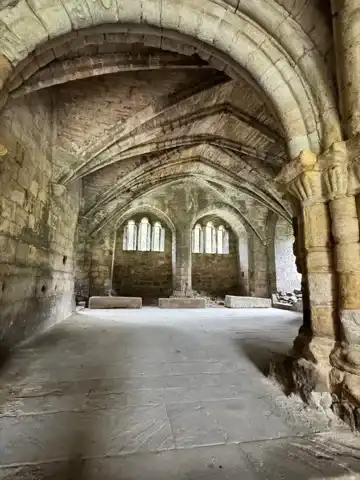
The most complete room is the chapter house. It is mostly still there. And it has a roof, which is more than can be said for the other parts of the abbey.
Signs scattered around the abbey provide information about its history and the lives of the monks who inhabited it at the time.
A sign in the chapter house said the building is not the original. The sign said the original chapter house collapsed and was rebuilt. During the rebuild, they inserted coffins in the side walls, but it’s unknown whether they contained bodies or if they served to bolster the walls.
I have questions. The sign’s writer knew there were coffins in the walls (I didn’t see any coffins there today). Okay. Fine. How? Did the coffins survive until more modern times? If so, why would they not know if there had been bodies in the coffins? Couldn’t they open them up and look for bones or bone dust? I’m plagued by questions such as these.
The chapter house was so named because “The Cistercian monks met here every morning to listen to a chapter from the monastic rule written by St Benedict, to hear confessions, and to receive punishment for any sins they had committed.”
Initially, the monks’ lives were, well, monastic and primitive, to the extreme. However, that softened slightly over time. For example, when the abbey opened, the monks weren’t permitted to bathe. By the 14th century, this rule was changed. They were then allowed to bathe, but only once a month.
Originally, they didn’t cleanse themselves, and then they did it only once a month. I hope the abbey was well ventilated back then because the monks must have been rank.
Around this time, monks were allowed to speak more freely, and they started eating meat three days a week, supplementing the previous diet of stewed vegetables and bread. When they started serving meat, they built a separate meat kitchen. Hmm. The signage didn’t mention dairy in the diet, but I wonder if that was an omission and they needed a separate meat kitchen to keep kosher. Probably not.
At first, the abbot of the abbey was expected to sleep in the dormitory with the rest of the monks. However, he later got his own quarters with a basement, a main floor for welcoming guests, and an upper level that contained his bedroom. His lodging also had a sewage drainage pipe. Sounds like he became somewhat more comfortable than a monk.
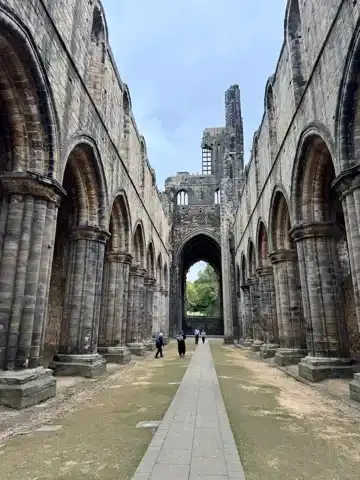
Most of the walls of the abbey’s church are there now, but the east wall was missing for a while. This absence wasn’t accidental. Less than a century after the abbey shut down, a road to Leeds was laid down. The road didn’t pass by the church. It ran through the church.
The road entered the church through the existing door on the west side of the building. They opened up the wall on the east side so the thoroughfare could exit the church there.
The church has no roof these days. I don’t know when that disappeared. But the ponderous, thickly fluted columns, and the arches above them, that held up the roof still stand.
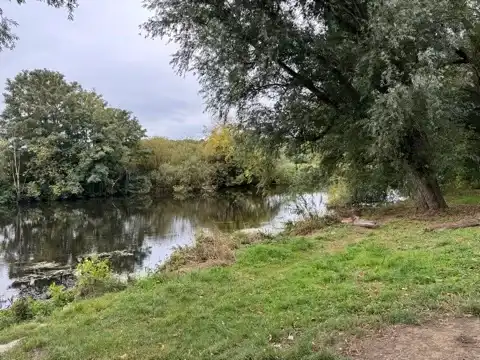
The abbey’s grounds are lush with grass and trees. They sit beside the River Aire. I’m happy to say there are also some nice benches.
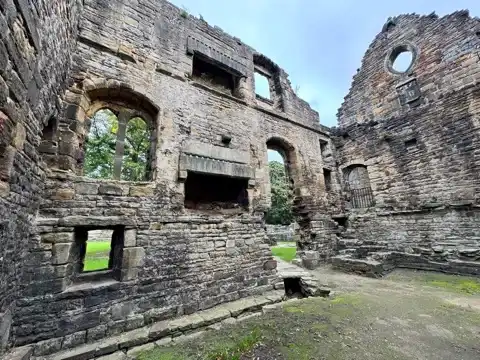
The remains of a small abbey guesthouse sit on the grounds, but those ruins are quite sparse. A stub of one wall pokes up from the ground. Other than that, little more than a low outline of the walls remains.
Kirkstall Abbey and its grounds are quite beautiful.
Abbey House Museum
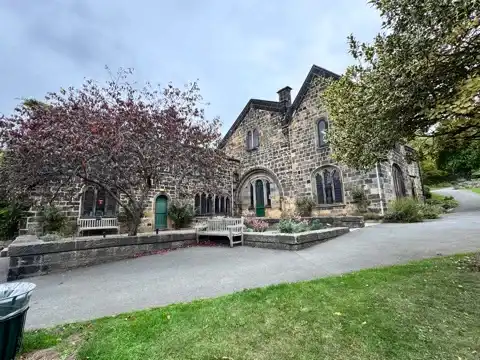
Just on the other side of the road that no longer runs through Kirkstall Abbey’s church is a small museum called the Abbey House Museum.
Despite the name, the contents have virtually nothing to do with Kirkstall Abbey. It’s so called because a part of the museum used to be one of Kirkstall Abbey’s gatehouses. That portion of the building served as a private residence until the 1920s.
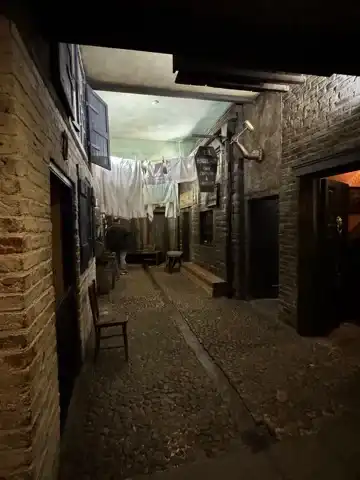
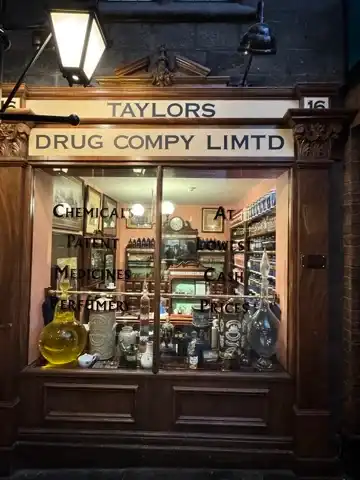
They then added to the building to create the museum. The addition consists of two levels. The lower level is an old cobblestone street with old shops on either side. The cobblestones and shops are not new. They were disassembled from different places and reconstructed in the museum.
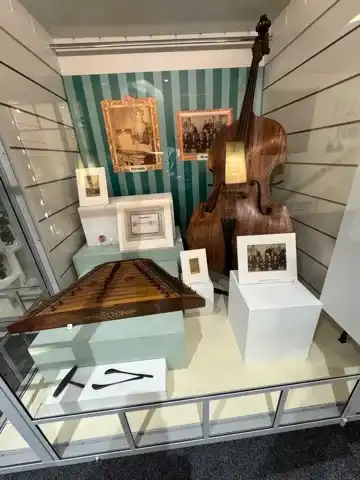
The museum has a second floor. It’s much more modern-looking and contains display cases with information about industries and products from, and life in, Leeds. Some display cases contain information about and pictures of a few local personages.
It’s a small museum, and worth only a brief visit, but if you’re going to the Kirkstall Abbey across the road anyway, you might as well pop in. What else have you got to do with your time? But maybe that’s just me.
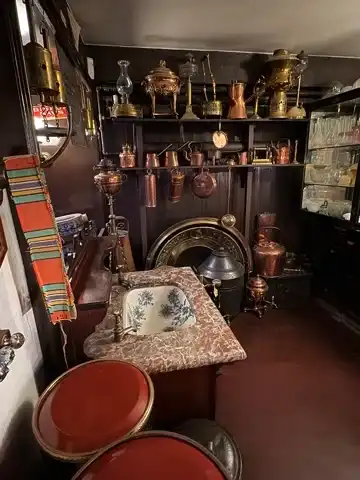
Pictures from in the Abbey House Museum:
Greggs Sausage Roll
On this trip, and at least one previous trip, a dear relative told me that I had to try a Greggs sausage roll because it’s a UK institution. I hadn’t done that before today.
After I finished at the museum, I took a bus back into the centre of Leeds and headed to a Greggs. I can now check off eating one of their sausage rolls from my list of must-do activities.
It is a somewhat tasty sausage baked into a light, savoury pastry roll. It was enjoyable, but worth doing primarily because it’s a tradition, not because it’s a culinary delight.
So ended my morning in Leeds. I’ll be back soonish (hopefully within a few hours) with an afternoon post.
Discover more from Joel's Journeys & Jaunts
Subscribe to get the latest posts sent to your email.
Leeds City Museum, Art Gallery, and Some Arcades
Leeds Park Square, Corn Exchange, St. John the Evangelist Church
Those enterprising Leedites! (What do they like to call themselves?). It sounds like they’ll stick a street into anything! What could be better than a street? A street in or through a building, that’s what! The abbey and its surroundings were very atmospheric and beautiful, and a charming looking little museum. I have yet to sample a Gregg’s sausage roll, although I heard about it from the same, dear source. But then again, I know how eager you are to ingest local culture wherever you are, so good for you! That is another authentic experience done and dusted.
Now that you mention it, I don’t know what one calls people from Leeds. Leedites sounds close enough to Luddites to be almost insulting. But who knows?
I thought it was rather rude and vulgar of them to put a road through the ruins of a beautiful old church, in the ruins of a beautiful old abbey. I’m glad they took it out.
Done and dusted? Damn. Was I supposed to dust the sausage roll before eating it? Why didn’t anyone tell me that?