2 Parks and a Pylon
So begins my final full day in Sydney Australia, the last of my stops in this country/continent. It’s been a long trip, but I can’t believe it’s almost over. Almost, but not quite. This morning I visited two parks and a pylon.
“A pylon,” you ask? “Whatever would possess you to visit a pylon?”
Well, it’s not just any pylon. If you think about the iconic structures of Sydney you might be able to guess which one this particular pylon helps to support. If you can’t guess, sorry. You’ll have to wait (or skip down and look at the subtitles). There are two parks to visit first.
Goods Line
One of the guidebooks I’m using describes Goods Line as Sydney’s answer to New York’s High Line. If the Goods Line Park is the answer, I’m not sure what High Line’s question is. Maybe, “Is that all you’ve got?”

I walked the length of High Line in New York some years ago, and I’m going only from memory, but I’m pretty sure that Goods Line Park is a tiny fraction of the length of High Line Park. Goods Line is only about two blocks long. And the Goods Line is nowhere near as interesting.
Where the two are similar is that they’re both public spaces, essentially linear parks, built on abandoned elevated railway lines.
The Goods Line is in a section of Sydney where the buildings are much shorter and less shiny than in the centre.
At the end of Goods Line opposite from the end where I entered, a short section of the old track still exists, exposed through the concrete deck. That track dead-ends at a nondescript building. I assume the building came after the abandonment of the railway line because trains having to stop so the engineer could get out and open the building doors for the train to pass through would have been something of a bother.
One point of interest on the Goods Line is a building near the end where I entered. It’s the University of Technology’s Business School’s Dr. Chau Wing, a Frank Gehry building. In my unprofessional assessment, it is a stereotypical Gehry building. By that I mean it doesn’t look like anything that anyone would think to construct until Frank Gehry conceived it. And after he did, I suspect people either love it, hate it, or maybe somewhere in between. I fall into the really like, but not love category.
According to my guidebook, the building has been nicknamed “the crumpled brown paper bag,” which is an easier name to remember than “the University of Technology’s Business School’s Dr. Chau Wing building.”
Barangaroo Reserve
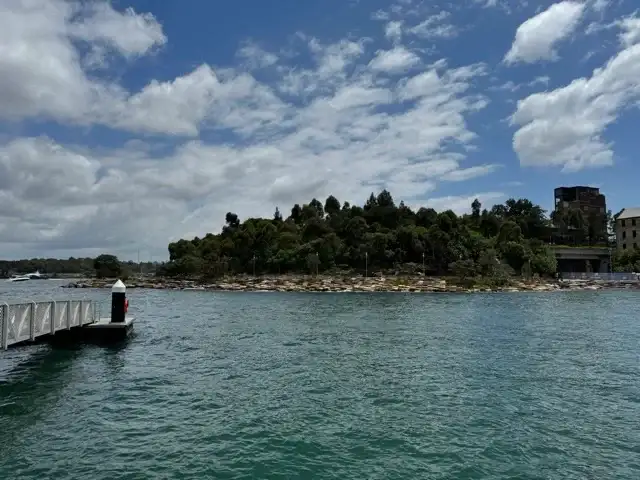
The Barangaroo Reserve is a park located beside the Sydney Harbour, just past where the eastern side of Darling Harbour ends. Toward Sydney’s core, along the eastern side of Darling Harbour from Barangaroo Reserve, is the Barangaroo district’s colourful, curvaceous, skyscrapers.
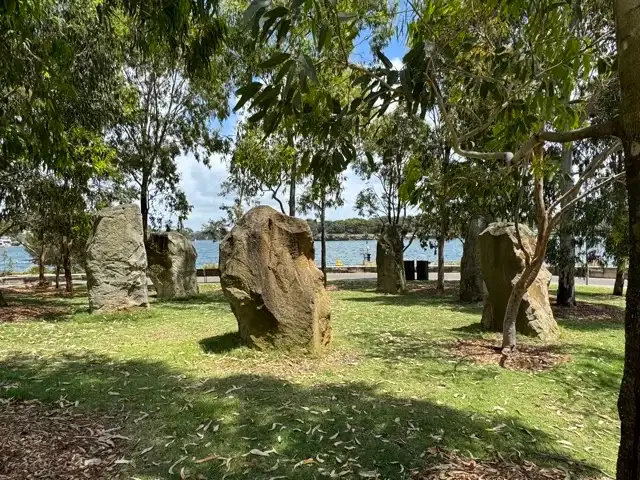
The reserve is built on a rocky hill. It is home to a lot of trees, shrubs, rocks, walking and cycling paths, and gorgeous views of Darling Harbour, the Barangaroo and other downtown skyscrapers, and the main part of Sydney Harbour. According to my guidebook, it’s designed to recreate the area’s original landscape.

Barangaroo Reserve is a small, but enjoyable piece of nature a short walk from a chunk of booming downtown Sydney.
Sydney Harbour Bridge Pylon Lookout & Museum

So, did you guess it? The pylon I referred to in the introduction is one of the pylons of the Sydney Harbour Bridge. Getting there caused me to take a little more of a wander than I planned.
Google Maps told me it was about a twenty-minute walk from Barangaroo Reserve. It probably would have been if I hadn’t misinterpreted Google Maps’ route.
I figured that the entrance to the Sydney Harbour Bridge Pylon Lookout and Museum is at the base of the pylon, with a climb inside from there to get to the lookout. It’s not. The entrance is from the deck of the bridge. At the point of the pylon, the bridge is already a fair piece above the ground.
When I got to the base, saw no entrance, and figured out that I had to enter from the bridge deck, I walked back toward where the bridge meets the ground. I didn’t walk far before I came to a ticket office for something called the Bridge Climb. I had already read about that and decided there was no way in hell I was going to do it (more on that later), but I stopped in at the office to ask how to get to the pylon museum and lookout.

The ticket seller courteously explained that I only had to walk a little further toward the start of the bridge and then take a glassed-in elevator to the bridge deck and walk to the pylon. Which is what I did.
From the door into the inside pylon on the bridge deck level, I walked up, I’m not sure how far, but maybe a third of the way up from the bridge deck. (I’m only guessing. The climb is indoors and I didn’t see any signs saying how many steps there are in that first part of the way up.)
After walking up those flights of stairs, I came to a level with a ticket desk, a small museum, and another set of stairs up to the pylon lookout. There is no charge to go into the museum, but there is a fee to walk up the remaining 132 stairs (there was a sign on that level) to the lookout. (If you go all the way up to the ticket desk, are you really going to just look at the little museum and turn back? Pay the money and get the full experience.)

The fee for adults is $24.95 (AUD), but for decrepit people of any nationality (a lot of places here restrict seniors rates to only Australians) it’s only $16. Maybe they figure a lot of seniors will die from the climb so they should get a discount for that.
The museum is quite small. It’s just one level in the interior of the pylon, and some of that space is taken up by the stairwell and ticket desk. The museum has two small rooms. One is a theatre that ran a set of contiguous video clips on the history, maintenance, and function of the multi-use bridge, which accommodates cars, bus-only lanes, sidewalks, bicycle lanes, and trains.
The other small room has some information panels about the bridge and artifacts such as an old lamp from the bridge, bolts, hinges, and more I’ve forgotten.
Walking the remaining 132 steps to the top of the pylon took me to a lookout with 360° views that provided amazing vistas of the harbour, the Sydney Opera House, downtown Sydney, and the surrounding scenery. Oh, and it also showed me a head-on view of the remainder of the bridge.

Remember I mentioned the Bridge Climb and that there was no way in hell I was going to do it? The head-on view of the bridge allowed me to see one of the climbs in progress.
Here’s the deal. If you buy a ticket for the Bridge Climb, you walk up one of the arched beams of the bridge to its summit. I didn’t see how they came down. They might have reversed course and walked down the way they came, crossed over on a beam at the summit and walked down the beam on the other side, or kept going on the same beam and walked to North Sydney on the far side of the bridge. I don’t know which.
The steps up the beam didn’t look particularly substantial to me, but they might just have seemed scant because of the distance the pylon is from the arched beams. The side rails are just a series of parallel wires strung through vertical posts.
Having seen it, I was particularly glad I had already decided not to do it. I would have been mortified if the bridge authorities had to pluck me off the bridge with a helicopter and rush me to a hospital after I entered a catatonic state as a result of extreme, traumatic acrophobic panic. That is to say, I’d be mortified when, after probably a month or two, I came out of my coma.
The pylon lookout was more than enough excitement for me.
Lunch
After leaving the Sydney Harbour Bridge Pylon Museum and Lookout, I walked to the nearby The Rocks district and found a little cafe where I had a smoked salmon sandwich and a glass of wine. The sandwich included a small green salad.
As I ate my lunch, I typed a few of these words on my phone, and planned my afternoon, the last afternoon of this trip. Sigh.
Discover more from Joel's Journeys & Jaunts
Subscribe to get the latest posts sent to your email.
Sydney Opera House and a Peninsula

St. Mary’s Cathedral, Sydney Tower, Museum of Sydney
I liked that crumpled bag building, and what a beauty that Sydney is along its harbours. There is not a world in which I would imagine that you would want to do that bridge climb, although you have surprised us before. As you say, you got the view anyway without tapping out your travel insurance on prolonged hospitalizations.
Sydney is a fabulous city. And, yeah, I have my limits about, not so much the height, put the nature of the route for a climb.