Port Arthur

I took a day trip out of Hobart to Port Arthur today. If you aren’t familiar with Port Arthur, Tasmania, Australia, you’re probably thinking, “Port Arthur, that sounds lovely.” And if that is what you’re thinking, you’re right. It has more scenic splendour than my words can begin to depict.
But that’s not what put Port Arthur on the map. In 1830, a timber station using convict labour opened there. The convict settlement aspect of it grew and expanded to include other types of labour. Port Arthur then became where the British sent repeat offenders and particularly incorrigible convicts.
But more on that later. The tour made a couple of stops before getting to Port Arthur. And there was, of course, the journey there.
But before even that, a couple of housekeeping notes. I’m breaking with my recent tradition of posting two entries a day, one for my morning activities and one for the afternoon, and only posting one today.
There are two reasons for that. For one, lunch was in the middle of the major activity, exploring the Port Arthur Historic Site. And lunch was a so-so sandwich at the cafe there, not worth discussing. So I don’t have a natural place to break this entry.
Second, I don’t think I’ll have a lot to say. This will probably be a longer-than-usual entry as a single post, but it’ll probably be too short to be worth splitting in two. Then again, I’ve only just started writing it. Sometimes I surprise myself with the excruciatingly lengthy claptrap I can spew. We’ll see how it goes.
Tomorrow will be a single-post day too. I’m booked on a flight scheduled to leave at 11:50 in the morning for Melbourne. I’ll have to head to the airport too early to do anything here in Hobart. So, barring any serious flight delays, my single post tomorrow will probably be solely about Melbourne.
Okay. The housekeeping is done, thank goodness. I hate housekeeping. Or, rather, I would hate it if I did it. If health inspectors ever enter my condo unit they’ll condemn it. I hope I can still get in when I head back home.
Along the Way to Port Arthur

Darren, the tour driver/guide, gave a running commentary on the way to Port Arthur. In amongst telling us about what we were seeing, and what we were going to see, and providing some interesting historical and geographical notes, he included a lot of excruciating groaner puns. For example, when we passed two vineyards, one on each side of the road, Darren said, “I don’t know if you can hear it, but every time I pass by here I hear a loud, high-pitched whining (wining) noise.”
Later, we passed a cheese factory. Daren pointed it out by telling us that they make mainly soft cheeses, like Brie. “A few years ago there was an explosion there and there was a lot of de Brie (debris).”
I’ll spare you the rest of his puns because I respect you too much. But, they set my mind thinking, something for which it doesn’t have a lot of experience.
This wasn’t an independent, small tour. It was a big bus run by a large company that I’ve seen running tours in other cities around the world, Gray Line. According to the reviews on Viator, the booking engine I used to book the trip, Darren isn’t the only driver on this particular tour.
So what I want to know is, was this Darren’s patter? Or did Gray Line give him the complete script? If the former, okay. I’ve put enough of my own excruciatingly bad puns in here. So I can hardly blame him for it. (Although, in my defence, I usually try to keep the puns down to only one or two per entry and on only the occasional post, not sprinkled liberally throughout almost every narrative.) But if it’s the latter, if Gray Line gave him the script including the puns, I want to have a word with the management.
But enough about that. The scenery along the way was lovely. We passed a lot of trees and greenish-brown grass on rolling hills of various heights. A few horses, more cows than horses, and lots and lots of sheep grazed in fields. Plus, there were the above-mentioned vineyards and others, along with farms, towns, and some forested areas along the way. It made for a very pleasing drive, particularly because I wasn’t the one doing the driving.
Two Stops

I mentioned above that the tour made two stops along the way to Port Arthur. The first was in the little town of Richmond.
It’s a fine town with, as far as I saw, a supermarket, a gas station, a park, a cafe or two, a couple of other stores, houses, public toilets, and an old Gaol left over from the convict settlement days.
A brief recording that plays over and over outside of the gaol says it’s the oldest remaining gaol in Australia that hasn’t been restored. The recording then invites people inside, for a fee, but it doesn’t mention the for-a-fee part. You have to step inside to see a sign telling you that. The stop in Richmond was less than 15 minutes. Darren told us there wasn’t enough time to go in the gaol. So I didn’t walk beyond the sign telling me I’d have to pay to go in.

I think the primary reason for the stop was the public washroom close to the gaol. As I said, Richmond is nice enough. I don’t mean to diss it in any way. But I didn’t see any reason to stop there other than to accommodate people who hadn’t gone before they left.
The second stop was at a lookout of which I forget the name. It was a very pretty view that we were allowed to see only out the window. Darren pulled into a turnout briefly and we had a gander without being allowed off the bus.
At Port Arthur Historic Site

Returning to the convict days of Port Arthur, punishment there and then was brutal. It usually consisted of hard labour, but they also used psychological punishments, such as sleep deprivation. The most horrific of that type of punishment was a small room with thick concrete walls and no windows. When the door closed, the cell the prisoner was locked in was silent and completely dark.
Punishment in this cell could last hours, days, or weeks, depending on the severity of the offence, with only very brief reprieves from the longer sentences.

The purpose of this punishment was to break the prisoner. It worked. Port Arthur had to build an insane asylum on the site to house some of the broken men. Eventually, that punishment was considered to be cruel and inhumane and it was ended.
Today, many of the buildings at the Port Arthur Historic Site are ruins, just shells or even less. Fires and looting did much of the damage. Others are gone completely. But there are some buildings still standing largely intact.
The commandant’s house is one of them. Visitors are allowed inside to see the rooms, which have furniture in them. There are also descriptive texts throughout about the building, the rooms, and the various commandants who lived there. After Port Arthur’s days as a convict settlement, the commandant’s house served as a hotel for a while and then as a rooming house for a while.

The asylum I mentioned is still standing and mostly complete. Today it contains a small museum.
A few cottages that served the administration are also still standing.
The ruins, including a church, a guard tower, the penitentiary, and more are, obviously, many centuries, and in some cases, a couple of millennia, younger than, say, most Greek and Roman ruins, but they are quite evocative in their own way.

There is also manmade beauty that was already there back in the convict days. A long path leads to the ruins of the Government cottage, where officers and their families used to gather. A shorter, perpendicular path intersects it about halfway along its length. Rows of gorgeous flowers and bushes line both sides of both paths. According to the signage, linear gardens were there in the convict settlement days.
Throughout the site, signage speaks about some of the convicts who spent time there. For example, I learned that some of the leaders of the Irish Rebellion who were sentenced to death had their sentences commuted and they got shipped to Port Arthur instead. The most senior leader got his own cottage up on a hill. (It’s still there.) The guards feared he might try to instigate a rebellion at Port Arthur so they wanted to keep him separated from the other prisoners.

Coincidentally, I learned a little bit about the Irish Rebellion at the museum at the Kilmainham Gaol on a visit to Dublin earlier this year. Some of the leaders of the rebellion who weren’t lucky enough to have their death sentences commuted were executed at Kilmainham Gaol. I didn’t know until today that some of the rebellion leaders were sent to Port Arthur as their punishment. The juxtaposition of the two trips was purely coincidental.
I also learned that some Canadian rebels from the time when Canada was still a British colony were sent to Port Arthur for being, well, rebellious. Because it was the British doing the expelling, it was mostly French people who were expelled.
This former convict settlement is set in some of the most gorgeous scenery you can imagine. Port Arthur is on a small bay, that’s off a large bay off the ocean. A couple of islands dot the bay. And tree-covered hills surround the whole area.
The tour included a half-hour cruise around the harbour. Beautiful. Beautiful. Beautiful.
Port Arthur Massacre

Tragically, its convict history is not the only thing that Port Arthur is famous for, and that history would be tragic enough. On April 28, 1996, a gunman killed 35 people and injured 23 others there. The Port Arthur Massacre was the most deadly mass shooting in the history of Australia.
Today, there is a memorial garden with a reflecting pool and some plants at the Port Arthur Historic Site to commemorate those who lost their lives. More importantly, not long after the massacre, the state and federal governments passed what are among the strictest gun control laws in the world.
I remember the same thing happened after mass shootings at two mosques by one gunman in Christchurch, New Zealand killed 51 people and injured 40 in 2019. The New Zealand government greatly tightened the country’s gun control laws after that. If memory serves, they introduced legislation in days, or at most weeks, after the shootings and passed the legislation quickly.
Meanwhile, in the United States, it seems they have mass shootings practically every day. Unless there are more than, maybe, three or four deaths, it may not get much news coverage beyond the local media because it’s so common.
You can probably name a number of the major American mass shootings as easily as I can even if you, like me, are not American.
Children gunned down in schools. Venues as diverse as synagogues, mosques, and gay clubs suffer horrific killings. In one shooting in Las Vegas alone in 2017 a single gunman killed 60 people and wounded more than 400.
And after each shooting, what do the authorities do? They think and they pray. You’d imagine that after repeating the same action (thoughts and prayers) over, and over, and over again getting the same result (more mass shootings) they might think it would be a good idea to try something else. Apparently not.
Countries that value human life have one horrific mass shooting say, “Enough of this. We’re going to do something to reduce the risk. Life is too precious to keep it easy for someone to do this again. We’re going to make it more difficult to get the most deadly kinds of guns.” Countries that don’t value human life, don’t.
Wow. That was a rather dark political rabbit hole I plunged into head first, wasn’t it? Sorry about that.
Let’s move on to more pleasant things.
Remarkable Cave

The tour I took included a free optional side trip. Those who wanted to go on it, which was the majority of the people on the tour, boarded the bus about 50 minutes before the non-side-trip departure time from the Port Arthur Historic Site. Darren then drove us to the Remarkable Cave and back in time to pick up the other passengers.
“Remarkable Cave” is capitalized because that’s its official name, not just a descriptor. It is kind of remarkable, but I might argue against its designation as a cave.
Remarkable Cave is a large rock by the coast. A set of 120 sturdy (Darren provided that number) metal steps took me down to a viewing platform where I could look at the glory of Remarkable Cave.
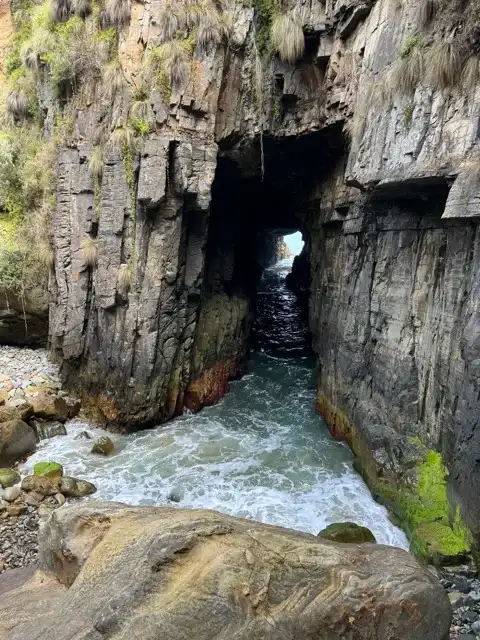
Over time, the pounding of waves carved a tunnel through the rock so that you can see through it to the ocean from the other side of the rock. And waves come flowing through the tunnel. That’s what’s now called Remarkable Cave.
It is beautiful and, as I said, I dare say remarkable. But to my mind, a cave isn’t open on both ends. I don’t know what sort of specialist determines what is and what isn’t a cave (a geologist?), but I’d like to get a ruling from one of them. As far as I’m concerned, it’s a natural tunnel, not a cave. It’s no less remarkable for it, but it’s still not a cave.
The views from a lookout at the top of the steps down to Remarkable Cave are also, well, remarkable.

The Road Back
Darren took a different route back to Hobart than the route he took going out to Port Arthur. The way back was even more gorgeous than the way out.

We spent a long time driving along the coast. It is varied and stunning, with lots of bays and inlets. Some sections have thin, but long sandy beaches. In other sections, sheer rocks abut the water. Elsewhere, hills gently roll into the sea. In still other places, the vegetation creeps almost right to the ocean.
We made one stop on the way back, at Tasmans Arch.
Tasmans Arch is a roughly similar structure to Remarkable Cave, but you don’t have to climb down any stairs to see it. And the borehole through the rock is much shorter. It’s maybe only half the length, if that.
So here’s the thing. Why is Remarkable Cave a cave, but Tasmans Arch is an arch? Is there some sort of official designation assigned by who knows who? And, if so, what are the criteria for that designation? If the hole is less than x metres it’s a natural bridge. If it’s between x and y metres it’s an arch. And if it’s more than y metres it’s a cave. Is that it? Enquiring minds want to know.
As we drove back into Hobart, I saw a large cruise ship docked in the port. This contradicts my statement of yesterday morning, but confirms my correction of yesterday afternoon. Large ocean-going vessels do dock in Hobart’s harbour.
Wow. That ended up longer than I thought it would, and I’m not quite done yet. The gun control rant took it a bit of the way there.
I normally somewhat secretly hope that millions of people find this journal so I can slap advertising on it and make enough money to afford to travel more. (Currently, ones of people find it.) But if that happens, I’m not looking forward to dealing with the comments from the gun enthusiasts, also known as gun nuts, on this post.
Hobart Summary
Because this is effectively my last day in Hobart, this is a good place for a summary.
Three nights, two days, was probably an appropriate time to spend here.
There aren’t many tourist attractions noted in my guidebooks that I didn’t get to. There is a Tasmanian Museum and Art Gallery. But it’s closed Mondays at this time of year. Yesterday was Monday. And today I was away at Port Arthur or on the way for all of its operating hours. So I missed out on that.
And a couple of companies run hop-on, hop-off buses to the summit of kunanyi/Mount Wellington. My guidebooks tell me there are great views up top. Purely accidentally, on my walk yesterday I passed by the ticket office of one of the companies that run buses.
I ducked in because I had questions.
“How long does it take?”
“It’s a hop-on, hop-off bus and there are walking trails you can do at the base and summit. But it’s an hour up and another hour down. So if you just go up, look at the views, and come down on the next bus, it’s about two and a half hours. But the views are spectacular on a clear day and it looks pretty clear today.”
Fair enough on the time. I hadn’t yet booked today’s tour, so it was doable without forfeiting too much time in Hobart itself. But the “it’s pretty clear today” thing? Um, not so much.
When I walked into the ticket office it was completely overcast. And when I had cast an eye toward the mountain that morning I could see the summit, but there was a light mist over it. I looked out the window in front of the ticket seller and saw that a small blue patch had indeed opened up. But it appeared to be contracting, not expanding.
And I had another question.
“What’s the temperature up there?”
“It’s usually 15 degrees cooler at the top than down here.” (Like back home in Canada, they use Celsius here. A 15-degree temperature difference is quite substantial. If I’ve done the arithmetic right, it’s a 27-degree difference in Fahrenheit.)
It was pleasant, but not at all hot at sea level. I didn’t pack warm enough clothes to be comfortable at the summit. The best I could do was a very light jacket over a very light sweater over a medium-weight long-sleeve shirt.
Yes, it is colder in Toronto, my hometown. But, back home, I live almost immediately beside a subway station. There’s a train from the airport with an indoor connection between it and the subway. In addition, the two train stations on either end of the airport line, which aren’t below ground, have platform doors that open only when the train is at the station. So, I had just a few steps in the cold wearing the above-described layered wardrobe when I left Toronto and I’ll have the same when I return. I figured that, rather than filling my suitcase with a lot of bulky clothes, I’d just bear the cold for a few steps.
But a half-hour on a mountain? I could do it, but I wouldn’t be comfortable. So I decided to forgo kunanyi/Mount Wellington. But if it had been warmer or clearer I probably would have gone up there and forgone something else. And if I had more time in Hobart I probably would have gone up despite the discomfort and imperfect view.
There are also other day trips I could have done from Hobart.
All that is an exceptionally long way of saying that if I had another couple of days here I could probably fill them quite enjoyably. But, at the same time, I’m not suffering from a particularly strong fear of missing out.
On to Melbourne. The travel gods willing, talk to you tomorrow.
Discover more from Joel's Journeys & Jaunts
Subscribe to get the latest posts sent to your email.


Some lovely scenery, picturesque ruins and interesting history. I am wondering a little on the cave thing. Could it have been a cave at one point, and then the water worked through and made it an arch? Yes, but that would likely have taken it thousands of years, and then, if the water didn’t surge through, what would have made it remarkable? The other, maybe more likely scenario, is that of some dad trying to get his kids to go look at this thing and failing to get them enthused about a ‘cool arch.’ Or maybe they’d been to Tasmans Arch, and all he could rouse was a ‘meh.’ A ‘Remarkable Cave,’ now that is a different matter. Pack the sandwiches, mom, we’ll be out of your hair for the afternoon!
On another note, no need to apologize for your anti-gun rant. If you did not do it, I would. I have.
Looking forward to hearing what you make of Melbourne.
As you say, it likely took thousands of years for water to carve out the “cave.” The holes on either end are large enough that I imagine they were both there before the word “cave” was invented. Although, I know nothing about these things, so I don’t know.
I think the paternal marketing theory is a good one.
Years ago I put a throwaway line about guns, one that I thought was totally innocuous, in a totally unrelated online article. It sparked a lengthy argument in the online replies from an American who insisted Americans need their guns to defend themselves and to right the wrong should an evil government come to power. It was not a fun discussion.
So, others may have been motivated as I was on the question of caves to check with the omniscient, omnipresent deity Google. The omniscient, omnipresent Google shows me the way-ay to the National Park Service and its guidance: “A cave is defined as an opening in the earth large enough to hold a person. Most caves are created when slowly-moving water dissolves, or eats away at limestone rock, creating spaces, caverns, and tunnel-like passages.”
OMG – I’ve just fallen into a rabbit hole on the above search, and find myself enjoying a vocabulary smorgasbord in a “Glossary of Cave and Karst Terminology.” I commend it to all. The sheer richness of earthly features to which names have been applied is delicious. Speleothem! Eccentric! Vermiculation! Remarkable….
And on the remarkable cave that launched a thousand quips: Tunnel. “A nearly horizontal cave open on both ends fairly straight and uniform in cross section.” Eureka!
Well, thank you for that.
Thanks for the cavernous information. And if the rabbit hole was big enough for you to fall into then it too must be a cave.