And Andong

And now, another city in my Southern Korean adventure, Andong. Getting from Busan, my previous destination, to Andong required a more than two-hour train trip, including a connection. I arrived at my hotel a little past 12:30 in the afternoon.
I’m here for three nights, so two and a half days’ worth of sightseeing. Today is Friday. The forecast calls for rain on Sunday. I’m not aware of any indoor attractions here. So, if the forecast holds, I don’t know what I’ll do then. I’ll probably persist in the rain. Maybe not. We’ll see, dear.
But today is today. And I did some stuff in Andong, namely, I walked for close to an hour to Andong Folk Village. But I saw and walked over a notable bridge on the way and visited a museum afterwards.
The walk started in what I think is the heart of Andong. I’m not going to sugarcoat it. I found that part of Andong, the part where my hotel is, uninspiring. Not ugly. Not threatening. Just kind of blah, without character or charm. I’m not a promoter of gentrification, but an iota wouldn’t hurt.

But it wasn’t the city itself that attracted me to Andong. That’s to come over the next couple of days.
Once I got out of the built-up area of Andong, which didn’t take all that long, the walk improved.
Most of the rest of the way was on a sidewalk close to a river, the Nakdong River.
For the first part, there were trees, bushes, and scrubland between me and the river. Railings kept me from interacting with the greenery or the river. But there was an opening where I was able to get a better look at the river. It’s lovely.
Then I came to a dam. I later found that the dam is, in English, ingeniously called the Andong Dam.

There is a walkway atop the dam that goes all the way to the far riverbank. I walked partway across to take pictures both upstream and downstream. Not surprisingly, the upstream side is wider and higher than the downstream side. Dams have a way of doing that. It’s in their nature.
I didn’t go all the way across the dam, nor did I look closely at the other side. That was probably a mistake, as you’ll learn later in this post.
The walk from there was much more pleasant, with the Nakdong River in full view almost right beside the sidewalk.
On the other side of the sidewalk from the river, there’s a two-lane, two-way road with cars wizzing by. The far bank of the river is not developed. It’s a lush, green mountainside. I tried to distract myself from the road by admiring the river and beyond.
Woryeonggyo

The Andong Folk Village is on the far side of the river from the one I was on. Fortunately, there’s a pedestrian bridge across the river close to the folk village. It’s the notable bridge I mentioned. It has a name, Woryeonggyo. Hello, Woryeonggyo. Nice to meet you.
It’s a charming, long wooden bridge, with a slight angle partway along it. There’s a somewhat raised pavilion with benches around much of its inner circumference on the bridge.

According to my guidebook, at 387 metres, it’s the longest pedestrian-only bridge in Korea. The guidebook also says that it’s only partly wooden. I didn’t see any non-wood sections. But I wasn’t paying close attention. And I do not doubt that there are bolts and such that aren’t wood. Maybe that’s what it was referring to.
I took some pictures of the river from there. It’s quite an attractive river, and the views from and of the bridge are handsome.
Andong Folk Village

The Andong Folk Village is just a short walk beyond Woryeonggyo. If you do a web search for “Andong Folk Village,” you’ll get a lot of hits for the Andong Hahoe Village or just the Hahoe Village. That’s not the Andong Folk Village.
I was going to keep this as a surprise, but what the heck. I’ve mentioned it now. I might as well spill the beans. The Hahoe Village is what’s touted as the major attraction of Andong, but it’s even farther out of the core of the town. I have to look at a map again, but I think it’s in the other direction. I’m not even sure if it’s formally a part of the municipality of Andong. I’ll be going there over the next two days, probably tomorrow. But I’ll be taking a taxi or bus, not walking.
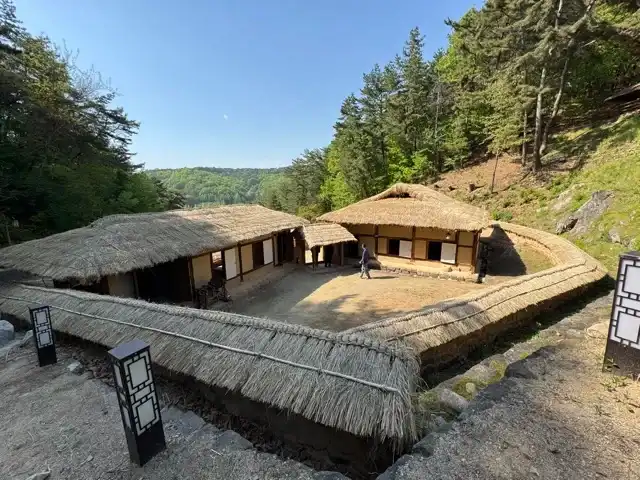
The non-Hahoe Andong Folk Village is not a village. It’s a collection of old, traditional buildings that were moved onto the site when the construction of the Andong Dam made it necessary to either move them or destroy them. They moved them.
By the entrance to the alleged village, there’s a pretty little pond.
The buildings in Andong Folk Village climb a hill, with a nice view from the top of the traditional buildings below and the river beyond.
Near each building, there are signs in Korean and English saying when the structure was moved to the site and what its purpose was. There is usually also a description of the layout and purpose of the interior rooms. A couple of signs provided a guess as to the general time of construction of the associated building, but the signs usually left that unsaid.
Andong Folk Museum

The Andong Folk Museum is not far from the Andong Folk Village. It was a pleasant surprise for me.
My walking tour app doesn’t have any information on Andong or anything in it at all. One of my guidebooks has a paragraph on the Andong Folk Village. As part of that paragraph, it mentions that, “There’s also a Folk Museum nearby. But that’s all it says about it.
My other guidebook lumps the Andong Folk Museum with the Folk Village, but then it talks only about the village.

So, to say I wasn’t expecting much would be a gross understatement. But it’s really close by, so I figured, what the heck? I might as well take a look. And, although I didn’t know this until I got there, the Andong Folk Museum, like the Andong Folk Village, is free. How could I go wrong?
Maybe it was because I had low expectations, but I really liked the museum. It’s small, just two not-particularly-large permanent exhibition galleries, but the information it presents is interesting. And the displays are engaging.
The exhibits are on Andong traditions and customs, as well as traditional crafts and tools. Most of the text was in both Korean and English. So, that was helpful. Mannequins played a major role in many of the displays, but there were also old books, tools, and other items on display, including an old chessboard and plastic renditions of traditional foods.

I found some of the bygone traditions concerning infancy and childhood to be interesting and strange. “Interesting” is not the word I’m looking for. Interesting is a euphemism for something else, but I’m not sure what. I’ll quote a couple of the customs here, and you decide.
The English version of a sign at one of the exhibits bore a title of “Selling Children.” According to the sign:
“When the infant and toddler mortality rate was high due to lack of medical techniques, people used shamanic ways and folk remedies to raise their children to be healthy and repel bad luck. The custom of selling children was one of them. It was a ritual wishing for a child’s health and longevity, choosing a natural object, spirit, or person as a foster parent. In Andong and other areas of Gyeongsangbuk-do, the ritual was performed around the first birthday of a baby. It was likely that the child would be sold to a natural object or person rather than a shaman, and the natural object was different depending on the year that the child was born in. That is, a child born in the year of the ox would be sold to a bush, the year of the rabbit to a mountain, the year of the rat to a crack in a stone wall, the year of the tiger to a big rock, and the year of the snake to a forest.”

Um. Parents sold their child to a bush, a mountain, or a forest? I hope they got payment up front. Bushes, mountains, and forests are notorious for welching on their debts. And, more than that, they sold their kids?!!! What the what?
And in a ritual, doljabi, at a child’s first birthday, “money, a bow, a book, a writing brush, a pair of scissors and so on are placed on the table and are used to predict the baby’s future depending on the item that he/she grabs first. It was believed that the baby would become a writer if the brush was picked and a general if the bow was selected.”
Unless they had a table large enough to hold a lot more stuff, it would have to be a rather limited set of career choices. Wouldn’t it be wise to give the child more options? Furthermore, is it prudent to lock the child into a career choice at one? And, is it smart to leave a pair of scissors on the table for a one-year-old to grab?

The museum had information about traditions (mainly left behind or modernized these days) for life events from infancy, through coming of age, marriages, 60th birthdays (which were considered special), deaths, and ancestor rites.
There was also a gallery in the museum containing a temporary exhibit. The sign in front of the gallery had a Korean title for the exhibition, and I think some other words about it. There was also an English title, “From Death’s Space to Life’s Space.” That was the only English in the entire temporary exhibition.
I didn’t get much out of the temporary exhibition, but I very much enjoyed the rest of the museum, little of it though there was.
Walking Back
I walked back to my hotel, roughly along the route I came—across Woryeonggyo, along the river and into the centre of town. Although I took a slightly different route within the city streets.

On the way back, I noticed something that I hadn’t noticed on the way out. On the other side of the river, the Andong Folk Village side, there looked to be a boardwalk, with railings running along the shore from Andong Dam to Woryeonggyo.
Damn. Had I known about that, it would probably have made for a much more enjoyable walk. As nice as it was, I didn’t really need to walk both forth and back across Woryeonggyo. I could have walked through the forested shore on the other side of the river one way.
However, on the way out to Andong Folk Village, I spotted an interesting pagoda on the other side of the busy street that ran beside the sidewalk. When I saw it on the way out, I figured I would take in my chosen objective, the village, first and cross over to see the pagoda on the way back. So, I would have missed it if I hadn’t come back on the other side of the river.
It’s a seven-storey pagoda. All but the base is made of bricks. The base is stone with some weathered relief sculptures. Above that, there’s a section of cement before the brickwork starts.

It’s not surprising that the relief carvings look weathered. A sign beside the pagoda says that the pagoda “is presumed to date to the founding of Beopheungsa Temple in the 8th century during the Unified Silla period (668- 935).” I expect I’ll be even more weathered when I get to be that old.
The sign goes on to say, “The pagoda is made of clay bricks and measures 17 m in height and 7.8 m in width at the base. It is the oldest and tallest extant brick pagoda in Korea. By the 18th century, this pagoda was all that remained of Beopheungsa Temple.”
That was not a bad little stop on the way back to my hotel.
And there’ll be more to come from Andong over the next couple of days.
Discover more from Joel's Journeys & Jaunts
Subscribe to get the latest posts sent to your email.


Look at you, reaping your rewards from your intrepidity! A lovely river walk. Well, maybe it could have been lovelier, but we take what we take and are well advised to be happy with it. Nothing wrong with the morning. Not only the sight that you set out for, but worthwhile bonuses along the way for your efforts. Impressive that you ‘stumbled’ upon that museum and historic pagoda. Who knows what else you will find in and around Andong? I hope the weather gods continue to smile upon you as you explore.
I’m sure there are wonderful things lurking around Andong for me to discover. Well, maybe not sure, but I have high hopes.