Palais Longchamp
After I finished this morning at Marseille’s Cathedral, it was raining. Fortunately, the rain was in the forecast, so, despite it being a sunny morning, I had the foresight to bring my umbrella.
I decided to walk to the Vieux Port, find a restaurant to eat at and plan rainy afternoon activities. Those activities primarily involved visiting the park at Palais Longchamp.
I know. I know. What was I thinking? A park in the rain.
Well, it wasn’t an entirely misguided plan. In addition to the park, Palais Longchamp contains two museums, one an art gallery and the other a natural history museum. I figured that if the rain became torrential or even just on the wrong side of the border between mildly unpleasant and downright uncomfortable, I could duck into one or both of the museums.
It was almost a half-hour walk from where I had lunch to Palais Longchamp. But there wasn’t much wind, and the rain wasn’t heavy, so I figured that my umbrella and mostly waterproof coat would suffice for the journey.
My hotel was close to the restaurant and only about a block or so off the route to Palais Longchamp. I decided to stop there to use my own bedroom to “freshen up,” to use the civilized euphemism for it.
Between my latish lunch and the stop at my hotel, I didn’t have a full afternoon for activities. I went only to Palais Longchamp and then returned to my hotel.
Palais Longchamp
At the entrance to Palais Longchamp, a sign greeted me with text in both French and, generously, English. My regular reader(s) probably expect me to say that the sign indicated that the Palais was closed.
No, that’s not it at all.
The sign informed me that Longchamp Park was created in 1849 to “celebrate the arrival of water in Marseille.
Wait. What? Water didn’t arrive in Marseille until 1849? Didn’t the inhabitants of Marseille get thirsty before then? I imagine it was a new source of water, not the first water the city ever had. But the sign didn’t make that clear.
The sign went on to say that the water arrived not by train or stagecoach, but rather by a new canal. In truth, the sign didn’t let the excitement build up by first eliminating the possibility of trains and stagecoaches. I added that. It leapt right into a mention of the canal. Some people have no sense of drama.
But that wasn’t all the information the sign provided. It also mentioned that the park was installed on what had been a zoo before.
Informative sign, that. But it’s a pity about the lack of drama. Maybe they should hire me to write their signs in the future. Maybe not.
Palais Longchamp Entrance
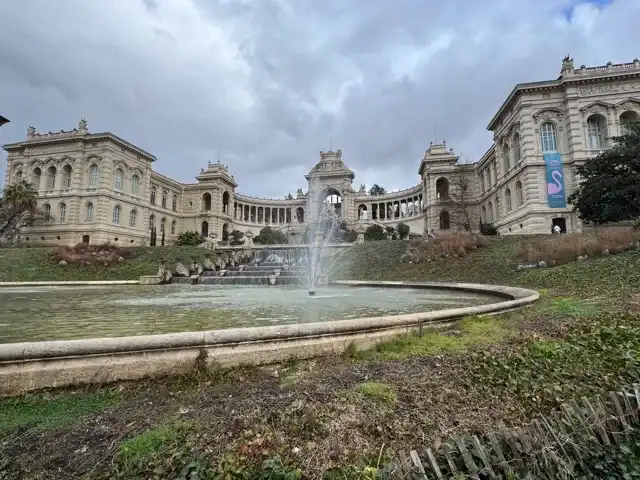
The entrance to Palais Longchamp is striking.
Just inside the gate from the street, there’s a circular decorative pool with a water jet shooting out of it.
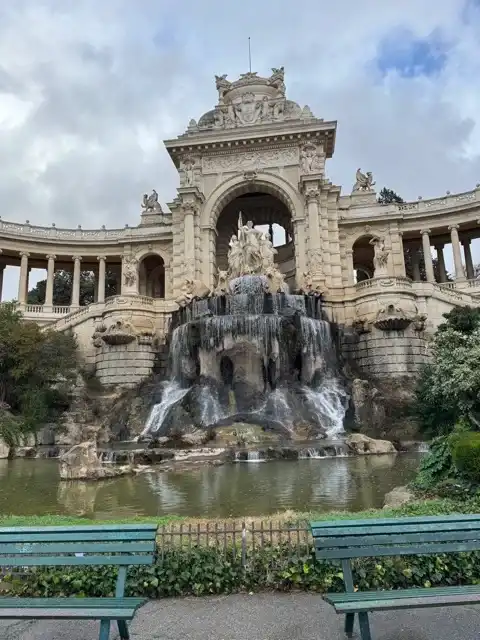
Behind that, there’s a more magnificent water feature. A waterfall gushes over a rock cliff into an irregularly shaped pool at its base*.
(*That is to say, that the water gushes over the cliff at least sometimes. It was turned off when I left Palais Longchamp. I guess the members of Don’t Let Joel See Stuff International Association—DLJSSIA—were tardy and didn’t make it in time to tell them to shut it off before my arrival.)
Atop the cliff, there’s a large statue of a manly man holding a staff. The man is flanked by two comely women. Four powerful bulls sit at their feet.
Grand staircases arc around either side of this statued water feature. About halfway up the grand staircases, there are entrances to two mirror-image, elegant buildings, each containing one of the museums I mentioned above.
At the top of the grand staircases is the entrance to Longchamp Park, most of which is on a plateau. The rain had stopped. So I decided to take a stroll through it.
Longchamp Park

I read that Longchamp Park is designed as a traditional French garden, with a traditional English garden embedded in it. I didn’t recognize the Frenchness of the broader garden or any Englishness within it. Then again, my idea of gardening is a few little-cared-for house plants. What do I know about French and English gardens?
Longchamp Park is quite attractive, with nice paths winding through it. It’s early February as I write this. There weren’t many flowers blooming, just some hardy, tiny flowers on a few bushes. But the grass was deep green, as were the leaves on the bushes. Some of the broadleaf trees were bare, but some still wore leaves. And there were a few coniferous evergreen trees. And there wasn’t a speck of snow. Not a speck. Nor would one have survived the low double-digit Celsius temperature for more than a second if anyone had placed a speck there.

That falls within the spectacular range for a grumpy old man from Toronto, Canada, who was primarily looking to escape Toronto’s winter for a few weeks. I don’t imagine I have to spell it out for you that the grumpy old man from Toronto is me.
But, in case I do have to spell it out for some people: the, T-H-E, grumpy, G-R-U-M-P-Y, old, O-L-D. … Okay. It was a weak and sickly joke to start with. There’s no point in my belabouring it any further. Let’s move on.
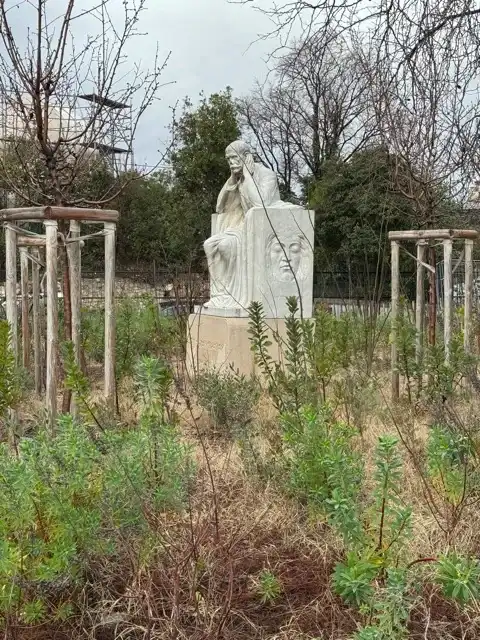
There are also some statues scattered throughout the garden.
There is an observatory in the garden. The website for the Palais Longchamp says it’s no longer used as an observatory, but rather as a data processing centre for data from the world’s telescopes. The site goes on to say that it’s open for school groups and the general public. Maybe I didn’t look hard enough, but I didn’t see a public entrance.
Le Musée des Beaux-Arts
The building that houses Le Musée des Beaux-Arts (The Museum of Fine Arts) at Palais Beauchamp is not terribly large. The exhibits are on two floors of it.
Like the permanent collection at La Charité Museum that I visited this morning, entrance to Le Musée des Beaux-Arts is free. And like this morning’s museum, I was still required to stop at the ticket desk and get a free physical ticket before I could go past the desk.
(Aside: I only just now noticed how strange “La Charité Museum” is. It mixes two languages in one name. That’s not the name the French use. They use the French word “Musée.” I copied and pasted “La Charité Museum” from somewhere. I forgot where. Because it wasn’t my original sin, I’m not going to go back and change it here or in this morning’s post.
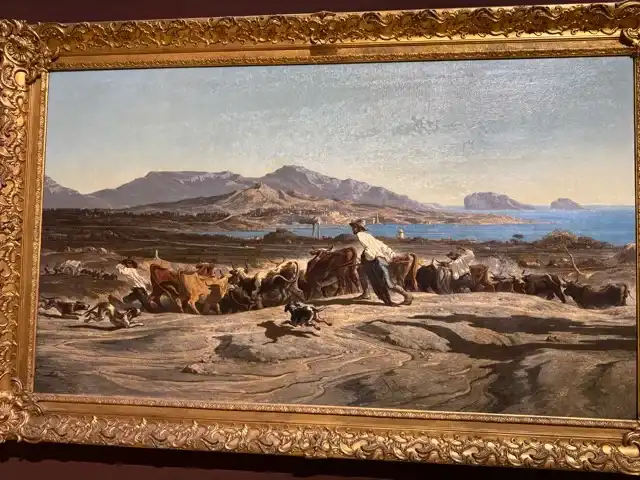
Émile Loubon
1853
All of the signage in Le Musée des Beaux-Arts at Palais Longchamp is in French. I didn’t see a lick of English. Using what little French I have, supplemented and verified by Apple Translate, I learned from a sign in the small lobby of the art gallery that the lower level contains works from the French, Italian and northern European schools from the 17th century. And the upper level contains a collection of works solely from the French school of the 18th century, and another collection of works both specifically from Marseille and from the broader French school of the 19th century.
The sign got the upper floor description right, as far as I saw. But on the lower level, among the mostly 17th-century works, there were a couple of huge sculptures and one large relief sculpture from the early 20th century.
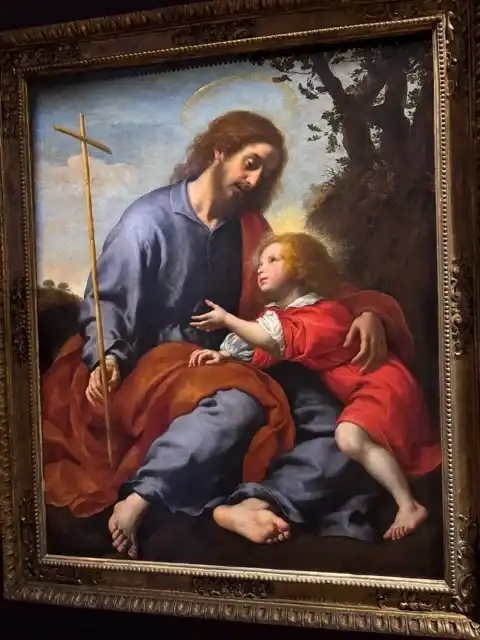
Carlo Dolci
Circa 1635
I’ll post just a couple of pictures, but I won’t talk about any of the works because I’m not equipped to do so. That is to say, I won’t talk about any except for one. It’s titled “Jésus enfant prenant la croix de saint Joseph.” It’s by Carlo Dolci of Florence and is dated circa 1635. The title translates to “Child Jesus taking up the cross of Saint Joseph.”
I checked and, as I suspected, Saint Joseph is the Joseph of Joseph and Mary fame. You know, the guy who was legally listed as Jesus’s dad, but who was allegedly cuckolded into that role by Mary and God. So, here’s what’s confusing me. Jesus is taking Joseph’s cross. Huh?
I’m not a Christian, nor have I studied Christianity’s stories, so maybe I’m just missing something. Joseph was Jewish. He couldn’t be Christian yet because he’d have to wait for his legal son to grow up for Christianity to become much of a thing. And, as I understand it, Christianity’s cross symbolized the cross on which Christ was crucified. So why does Joseph have a cross when Joseph was Jewish, and Jesus is still a child? And why is Jesus taking the cross from him? Did Jesus not want to mess up his legal dad’s Judaism?
It’s so confusing.
I said I wasn’t going to discuss any more of the artworks. So let’s move on. It’s getting late.
Le Muséum d’Histoire Naturelle
When I left the Palais Longchamp’s fine arts museum, it was raining again. So I thought a visit to the natural history museum was in order.
As I said, Le Muséum d’Histoire Naturelle (the Museum of Natural History) is in a building that’s the mirror image of Le Musée des Beaux-Arts building.
The Natural History Museum is also free, but they said, “To heck with tickets. What’s the point if it’s free?” In truth, they didn’t say that. But I’m sure they were thinking it, but thinking it in French. They simply let people in for free without requiring or even offering tickets.
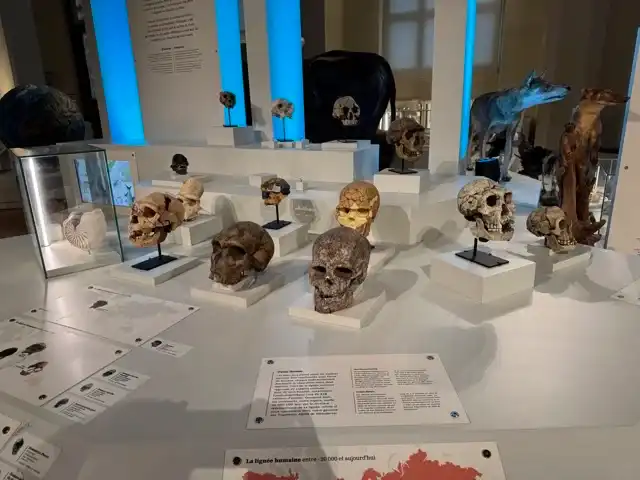
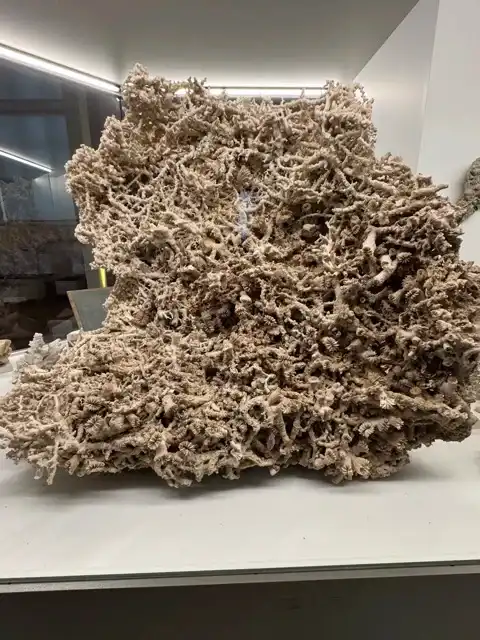
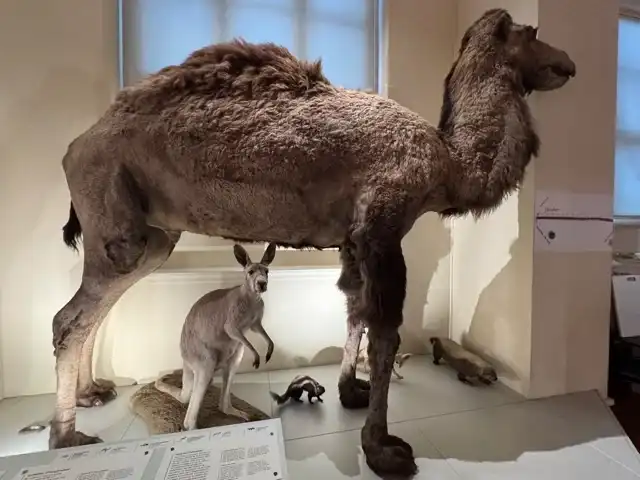
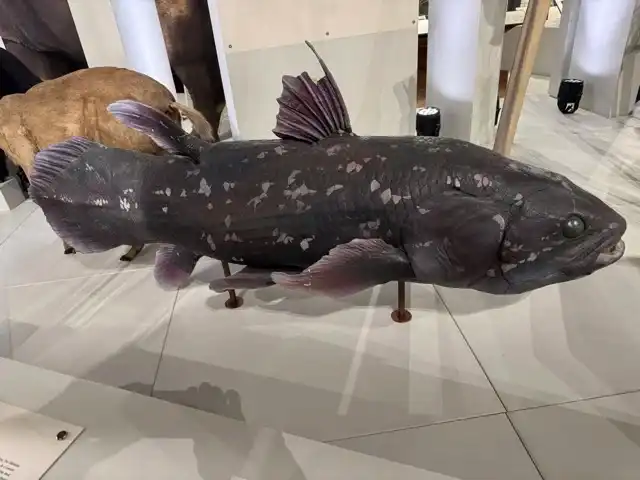
I mentioned above that the mirror buildings aren’t large. The permanent exhibition of the Natural History Museum is all on the first floor. It contains stuffed animals, skeletons (or more likely models of skeletons), a bunch of cool rocks and minerals, and some dried-out coral. There’s an interesting display about the evolution of humans with model skulls showing the progression from primates and protohumans to humans.
There was considerable text in the museum. And, fortunately, at least fortunately for me, most of it had English translations.
The upper level of the museum contains meeting rooms and a small space for temporary exhibits. When I was there, they had a small, fanciful exhibit on the creatures of Alice in Wonderland. I went up. I peeked in for a bit. And I quickly went back down, left the museum, and returned to my hotel to end the day.
Discover more from Joel's Journeys & Jaunts
Subscribe to get the latest posts sent to your email.
You ended with a fine fish. I am pleased, I am, but fortunately I did not lose my head like I did on the last post. Looked like a nice afternoon despite the raindrops. I could explain about the Jesus, Joseph, Judaism, cross thing, but why would I do that? I’d much rather hear you muse about it. Muse on, Joel Michael. Looking forward to the next post.
I figured you’d have an answer to the Jesus, Joseph, Judaism riddle. I’ll try to remember to ask you about it when I see you. Fat chance of me remembering that.
I try to include as many fish as I can in these pages for you.
Did you have to reveal my middle name? I tell people “Adventure” is my middle name. They don’t believe me, so Michael is as good as any, I guess.